
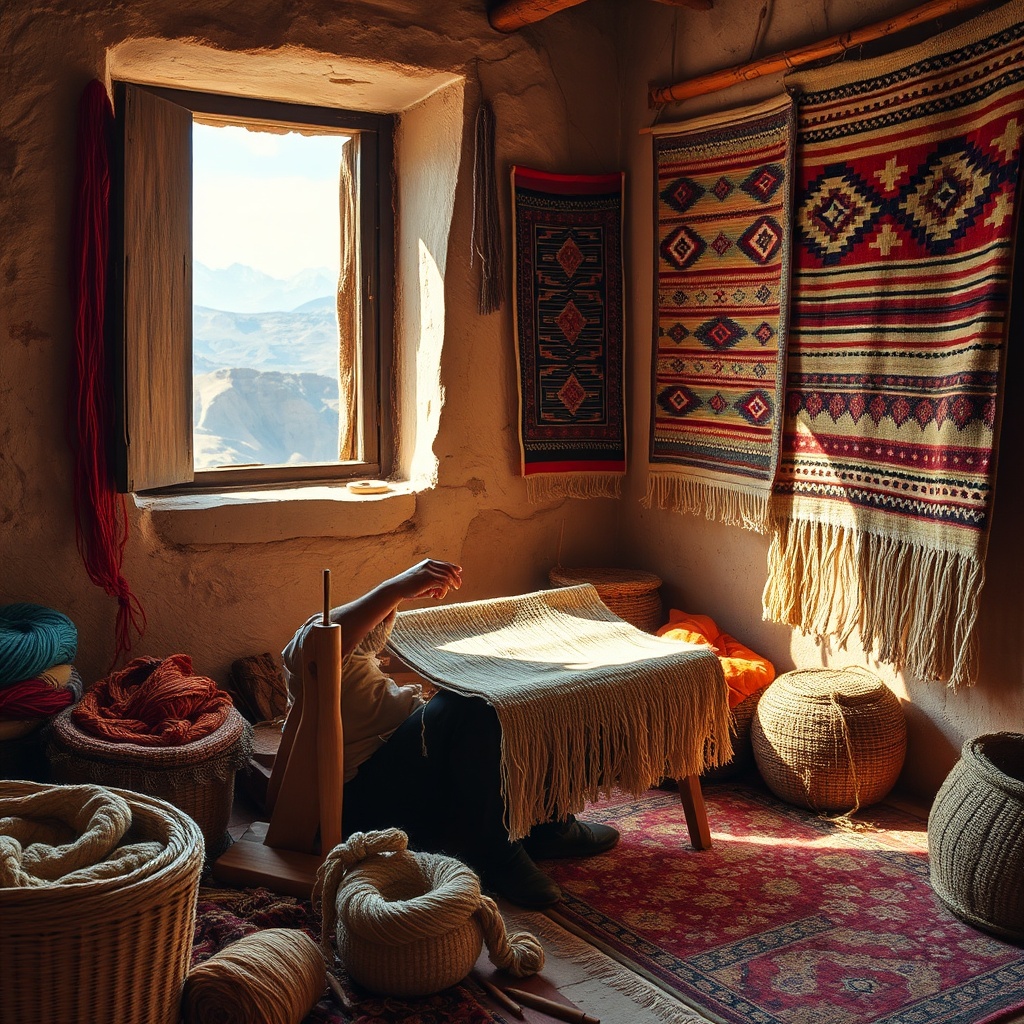
The History And Symbolism Of Berber Carpet Weaving
The History and Symbolism of Berber Carpet Weaving stretches far beyond the striking geometric patterns that adorn living rooms today. A single rug can hold a narrative of desert migrations, tribal alliances, and centuries‑old rituals, all woven into wool and dyed with pigments harvested from the land. When a traveler first encounters a hand‑knotted rug from the High Atlas, the vivid reds and deep indigos whisper stories of nomadic caravans that once crossed the Sahara. These textiles act as portable archives, preserving language in a world where oral tradition reigns. To find authentic Moroccan products, one can look for traditional Berber carpets.
Excavations at Tadrart Acacus uncovered wool fragments dated to 1,200 BCE through radiocarbon analysis, confirming that nomadic groups were already mastering spindle techniques. A 2018 study reported a calibrated range of 3,300 ± 50 years for a dyed sherd, making it one of the oldest known Berber textiles. These fibers, preserved in arid caves, reveal a palette of ochre, charcoal, and plant‑based blues, suggesting that early weavers experimented with locally available mordants long before trade routes introduced indigo.
The Rif mountains favor tightly packed knotting because the cooler climate preserves wool density, while the Atlas plateau encourages looser wefts that allow airflow in hotter valleys. In Kabylie, the prevalence of goat herding introduced fine goat hair into the warp, producing lighter rugs suited for interior wall hangings. Satellite mapping shows that villages within a 50‑km radius of the Moulouya River consistently incorporate river‑stone motifs, linking geography directly to visual language.
Elders from the Aït Ben Haddou tribe recount a legend in which the first carpet emerged from a dream of a moonlit oasis. The story, recorded by anthropologist Fatima Zeroual in 2004, describes a luminous “first knot” that bound the community together. Such narratives survive alongside material evidence, providing a cultural framework that explains why certain symbols—like the eight‑pointed star—appear across disparate regions.
The “hand of Fatima,” a six‑pointed star enclosed by a circle, functions as a protective amulet against the evil eye; artisans often stitch it near the rug’s edge to safeguard the household. Diamond motifs, composed of interlocking lozenges, represent fertility and the abundance of seasonal rains. In the Central Atlas, a stylized ram’s head signals a family’s pastoral heritage, while in the Souss valley the same shape denotes bravery in battle.
A three‑pointed star in the High Atlas signifies the three seasons of transhumance, yet the identical shape in the Rif conveys the concept of “homecoming” after pilgrimage. Researchers at the University of Marrakech documented 42 distinct interpretations for just five common motifs, underscoring the need to consider locality before assigning a universal meaning.
Pre‑Islamic Berber rugs featured solar discs and lunar crescents, reflecting indigenous cosmology. After the 7th‑century Arab expansion, Islamic calligraphy began to appear as border bands, integrating verses from Surah Al‑Fatiha. Ottoman influence introduced stylized tulip motifs during the 16th century, especially in carpets exported to Tunisian markets. A timeline of motif adoption illustrates how each religious wave layered new iconography onto an existing visual grammar.
High‑altitude sheep in the Atlas produce wool with a micron count of 18–22 µm, granting both softness and durability. Camel hair, harvested during the spring shedding, adds a coarse texture that enhances rug longevity in high‑traffic areas. Traditional indigo (Indigofera tinctoria) yields a deep blue when reduced with fermented urine, while madder (Rubia tinctorum) provides a stable red after a 30‑minute boil with alum mordant. Comparative analysis shows that natural dyes retain over 80 % of their hue after 50 washes, whereas synthetic counterparts drop below 60 % within the first ten cycles.
Vertical looms, anchored to a wooden frame and suspended from a ceiling beam, enable weavers to adjust tension with a foot pedal, producing dense knot counts of up to 250 knots per square inch. Horizontal looms, spread across the ground, favor broader designs, typically achieving 120–150 knots per square inch. The choice of loom directly influences the rug’s structural integrity; a study of 73 museum specimens found that vertical‑loomed pieces exhibited a 12 % lower rate of edge fraying.
Modern cooperatives in Ouarzazate experiment with recycled polyester blends, interlacing them with traditional wool to reduce material costs by 30 %. A 2021 pilot program reported a 45 % decrease in water consumption when using low‑impact vegetable tannins for dye fixation. Artisans who adopt solar‑powered looms report a 20 % increase in production speed without compromising knot uniformity. To find unique pieces like the Authentic Handmade Beni Ouarain rug, one can look for sustainable and eco-friendly production methods.
In Tizi‑Ouzou, the “Marrakech Sisters” cooperative recorded a 38 % rise in average household income between 2017 and 2019, driven by direct export contracts with European boutiques. Membership grew from 42 to 118 women during that period, illustrating how shared resources—such as communal dye vats and bulk‑purchase wool—lowered individual overhead.
A master weaver from the Aït Bou Mokrane clan teaches her 14‑year‑old granddaughter using a “hands‑on” apprenticeship that spans three years, covering knotting, dye preparation, and market negotiation. Recent surveys indicate that 62 % of apprentices abandon the craft before completing the program, citing urban migration and limited digital literacy as primary obstacles.
Export data from the Moroccan Ministry of Handicrafts show that Berber carpet shipments surged from 1.2 million USD in 2000 to 9.8 million USD in 2023, with luxury hotels in Dubai and Paris accounting for 27 % of total sales. Online platforms now list individual rugs at prices ranging from 1,200 USD for a 2 × 3 m piece to 15,000 USD for a hand‑knotted 4 × 6 m masterpiece, reflecting a growing appetite for authentic provenance. For those looking for luxury Genuine Leather Pouf Stuffed items, the market has many options.
The 1925 Paris Exposition featured a catalogue page showcasing a 2.5 × 3.5 m Berber rug, described as “a rare specimen of Saharan artistry.” The exhibition sparked a wave of acquisitions by French interior designers, who integrated the rugs into Art Deco interiors, cementing their status as symbols of exotic luxury.
Collectors rely on a three‑point checklist: (1) fiber analysis confirming wool age through microscopic scale patterns, (2) motif dating that matches regional stylistic evolution, and (3) loom marks—hand‑carved wooden tags unique to pre‑1970 workshops. Failure to verify any of these criteria often indicates a modern reproduction.
In 2022, a Scandinavian furniture brand partnered with a Moroccan cooperative to launch a line of modular sofas upholstered with Berber‑inspired woven panels. The collection blended traditional diamond motifs with minimalist silhouettes, achieving sales of 4,500 units within the first six months and earning a design award for cultural integration.
The History and Symbolism of Berber Carpet Weaving reveals a tapestry where archaeology, mythology, chemistry, and economics intertwine. From ancient loom remnants buried beneath desert sands to today’s high‑end showrooms, each rug encapsulates a living heritage that continues to empower women, sustain rural economies, and inspire global designers. By choosing ethically sourced pieces or supporting local cooperatives, readers can help preserve this vibrant craft for future generations.
**What do common Berber carpet symbols represent?** Symbols such as the hand of Fatima protect against the evil eye, diamond patterns denote fertility, and three‑pointed stars can signal seasonal migrations or homecoming, depending on the region.
**How can I tell if a Berber rug is authentic or a modern reproduction?** Examine fiber age under magnification, verify that motifs align with documented regional styles, and look for traditional loom marks carved into the back of the rug.
**What natural dyes were traditionally used in Berber weaving?** Indigo from Indigofera tinctoria produced blues, madder roots gave reds, and pomegranate rind yielded yellows