
Moroccan Traditions: A Journey Through Time
Moroccan Traditions: A Journey Through Time
Introduction
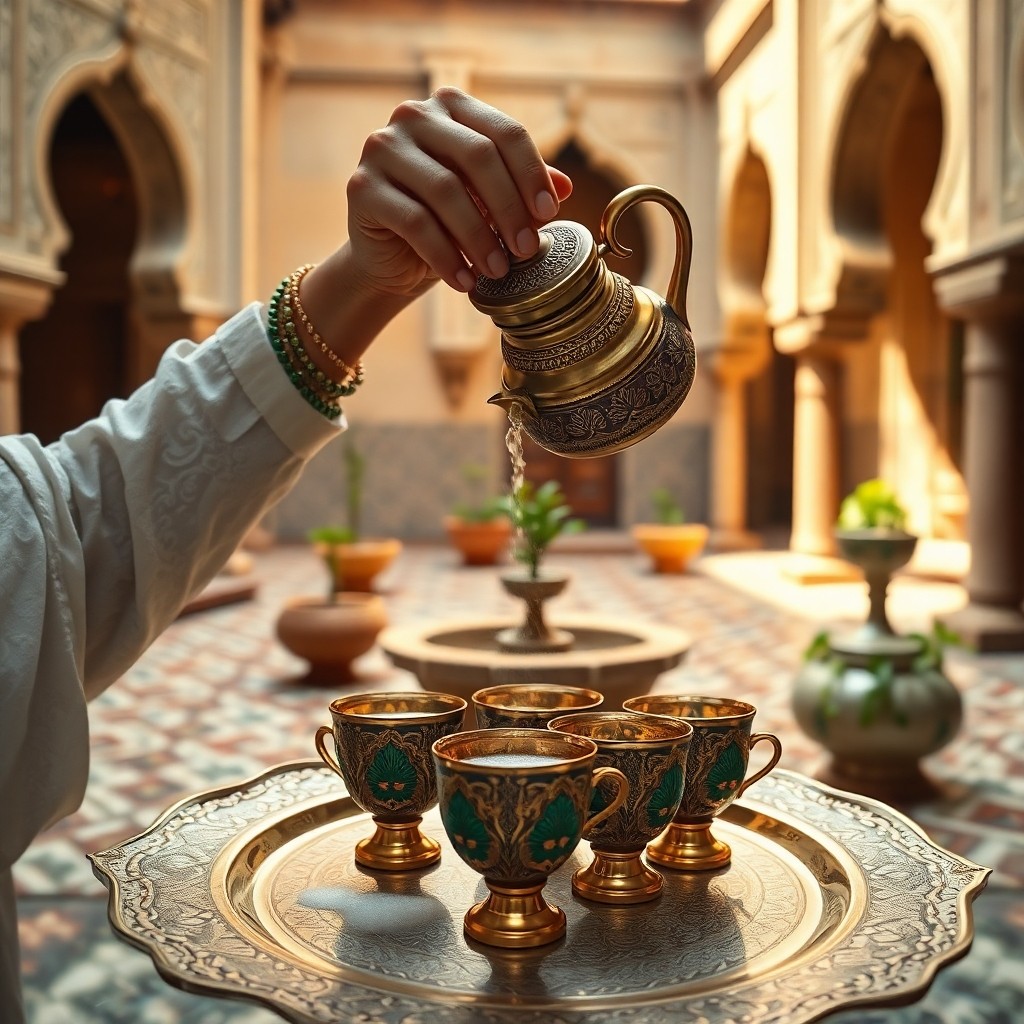
The call to prayer spills from the minaret of the Al-Qarawiyyin in Fez just as the first light creeps over the rooftops. Below, a woman kneels beside a low table, lifting a brass teapot nearly two feet above a row of small glasses. The amber stream of mint tea arcs through the cool morning air, foaming white at the rim of each glass. She pours, returns the pot to the tray, pours again — a rhythm she learned from her mother, who learned it from hers, stretching back through generations in a country where every gesture carries the weight of centuries.
Morocco sits at the crossroads of empires and continents. Berber civilizations rooted themselves in these mountains and deserts thousands of years before Arab armies arrived in the seventh century, bringing Islam and the Arabic language. Andalusian refugees fled north across the Strait of Gibraltar after the fall of Granada in 1492, seeding Moroccan cities with poets, architects, and musicians. Sub-Saharan trade routes threaded through the Sahara, bringing gold, salt, and spiritual traditions that took permanent hold in the south. The result is one of the most layered cultural landscapes on Earth — a place where Amazigh harvest festivals coexist with Sufi pilgrimage ceremonies, where a single wedding can draw from traditions spanning three continents.
This is not a surface-level overview of colorful customs. What follows is a deep dive into the specific, living practices that define Moroccan heritage — from the vanishing tattoo traditions of Berber elders to the mathematical devotion embedded in a single zellige tile. These are traditions that breathe, adapt, and endure, and understanding them requires looking past the postcard images to the people who keep them alive.
1. The Berber Foundations: Morocco's Oldest Living Traditions
Long before Morocco existed as a nation, the Amazigh people — the free people — cultivated barley in the High Atlas, navigated desert trade routes, and developed social codes that still govern community life in rural areas. Their traditions form the bedrock beneath everything else in Moroccan culture, and in recent years, they have experienced a powerful reclamation.
1.1 The Amazigh New Year (Yennayer) and Its Agricultural Roots
Every January 12–13, Amazigh communities across Morocco and North Africa celebrate Yennayer, the start of the agricultural calendar year. The date corresponds to the Julian calendar's January 1, a remnant of the period when North Africa interacted with Roman agricultural systems. In the Atlas Mountains, families prepare *tagula*, a porridge made from barley kernels cooked slowly with argan oil and amlou — a paste of toasted almonds, honey, and argan oil. In other regions, a seven-vegetable couscous is served, each vegetable representing a wish for the coming year: prosperity, health, fertility, peace, wisdom, strength, and unity.
In the Rif region of northern Morocco, Yennayer celebrations take on a distinct character. Families prepare *irki*, a dish made from dried fava beans cracked and cooked with olive oil and cumin, reflecting the Rif's Mediterranean agricultural patterns rather than the argan-centric cuisine of the south. Children receive small gifts of dried fruits and nuts, and elders recite oral poems recounting the year's events.
The celebration gained official recognition in 2023 when King Mohammed VI declared Yennayer a national public holiday — a landmark moment for Amazigh cultural rights in Morocco, coming decades after activists first pushed for formal acknowledgment of Amazigh identity in education, government, and public life.
1.2 Amazigh Tattooing: A Vanishing Language on Skin
For centuries, Amazigh women wore intricate tattoos on their foreheads, chins, cheeks, and hands — a visual language that communicated tribal affiliation, marital status, fertility, and spiritual protection. The chin tattoo, often a small cross or star shape called *semmassa*, symbolized the connection between earth and sky. Cheek markings represented specific tribal lineages, allowing women to identify each other across vast distances in the mountains and desert.
The practice declined sharply in the mid-twentieth century as urbanization, religious reform, and modern beauty standards discouraged tattooing. Today, the oldest generation of tattooed Amazigh women — many now in their eighties and nineties — represent the last living bearers of this tradition. Photographer and researcher Lauren Randolph spent years documenting these women across rural Morocco, capturing portraits that serve as both art and anthropological record before the knowledge disappears entirely.
A revival movement has emerged among young Amazigh women who are reclaiming the symbols through temporary henna applications and contemporary jewelry designs inspired by traditional tattoo patterns. It is not about replicating the permanent marks but about reconnecting with a visual heritage that was nearly erased.
2. Moroccan Weddings: A Multi-Day Tapestry of Ritual
A Moroccan wedding is not a single event — it is a sequence of ceremonies that can last anywhere from three days to a full week, depending on the family's region, means, and ambitions. Each phase carries specific symbolic weight, and the rituals vary dramatically between cities and rural communities.
2.1 The Henna Night (Laylat Al-Henna): Symbolism and Step
The henna night, held one or two days before the main wedding celebration, is traditionally the bride's event — organized by her female relatives and friends, with the groom's family arriving later as honored guests. The evening follows a structured timeline. It begins around sunset with the arrival of the *neggafa*, a professional dresser who oversees the bride's presentation. The neggafa selects from a wardrobe of caftans — often three to seven outfit changes in urban celebrations like those in Fes or Casablanca — each layered and accessorized with heavy gold jewelry, elaborate belts, and matching headpieces.
The henna application itself is performed by a skilled elder or professional henna artist. The patterns carry meaning: geometric lines represent protection from evil, floral motifs symbolize fertility and joy, and dots placed at specific points on the hands are believed to activate spiritual energy centers. The bride's palms and feet receive the most intricate designs, while female guests receive simpler patterns on the backs of their hands. A key ritual involves the groom's mother presenting the henna paste to the bride as a gesture of welcome into the family.
After the henna dries — typically two to four hours — the bride's hands are wrapped in cloth to deepen the stain. The evening concludes with a feast and singing, often led by a professional *adawat* ensemble of female musicians.
2.2 Regional Wedding Variations: Fes vs. the Sahara
In Fes, the wedding is a display of urban sophistication. The bride may change outfits seven times throughout the celebration, each caftan representing a different Moroccan textile tradition — from Fassi silk brocade to hand-embroidered velvet from Meknes. The *neggafa* and her assistants orchestrate each appearance like a theatrical production, and the event can cost families tens of thousands of dollars.
In the Sahrawi communities of southern Morocco, weddings operate on an entirely different logic. The celebration is communal — the entire village participates, and the economic burden is shared collectively. *Amarg*, a tradition of Saharan poetic singing performed by specialized groups, structures the event. Poets compose verses in praise of the couple, recount family histories, and offer moral guidance for married life. The *Amarg* singers perform call-and-response patterns accompanied by hand drums and the *tbal*.
One distinctive Saharan custom is the *touiza* procession, in which the bride is carried to the groom's family home on a decorated camel, accompanied by singing women and drumming men walking alongside. The communal feast that follows can feed hundreds of guests, with whole roasted lambs served on massive platters of couscous — a logistical feat organized entirely by volunteer labor from the community.
3. Moroccan Cuisine as Living Heritage: Beyond the Tagine
Moroccan food traditions extend far beyond the dishes that appear on restaurant menus abroad. The rituals surrounding eating — the preparation, the serving, the social context — carry as much cultural significance as the flavors themselves.
3.1 The Art of Moroccan Tea: A Ritual, Not a Beverage
Moroccan mint tea — *atay* in Arabic, *atay* in Amazigh — is the country's social lubricant, its greeting ritual, its negotiation tool, and its daily rhythm. The preparation follows a precise method. Gunpowder green tea (typically a Chinese variety imported through historical trade routes) is rinsed briefly with boiling water to remove bitterness, then combined with a generous handful of fresh spearmint and a cone of sugar — sometimes exceeding 50 grams per pot. The mixture steeps for three to five minutes.
The pouring technique is critical. The server lifts the pot at least twelve inches above the glasses and pours in a thin, steady stream. This aeration creates the foam — *raghwa* — that signals a properly made tea. The first glass is poured, returned to the pot, and the process repeated to ensure even distribution of mint and sweetness.
A well-known proverb captures the philosophy of the three-glass ritual: the first glass is as gentle as life, the second as strong as love, the third as bitter as death. In practice, refusing the third glass is impolite — it signals that the guest wishes to leave or, worse, that the host has somehow failed in hospitality. In business settings, tea precedes any negotiation; to skip it is to signal disrespect.
3.2 Bread as Sacred: The Communal Oven (Ferrane) Tradition
In neighborhoods across Moroccan cities, the *ferrane* — the communal wood-fired oven — remains a daily institution. Each morning, women prepare flatbread (*khobz*) at home, kneading dough with flour, salt, yeast, and sometimes anise seeds or sesame. Before the dough goes to the oven, each family presses a unique identifying mark into the loaf's surface — a pattern of pinpricks, a fork design, or a wooden stamp passed down through generations. This ensures that when dozens of identical-looking loaves emerge from the communal oven, each family can claim their own.
In the medina of Fes, some ferrane have operated continuously for centuries, their stone vaults blackened by generations of wood fire. The oven attendant — the *karan* — manages the timing, rotating loaves with a long wooden paddle and calling out when each family's bread is ready.
Bread holds sacred status in Moroccan culture. A piece of bread found on the street will be picked up and placed on a wall or ledge rather than discarded. During Ramadan, *khobz* accompanies every *iftar* meal, and the first bite of bread before breaking fast carries particular blessing. This reverence reflects both Islamic teachings about sustenance and older Amazigh beliefs about bread as a gift from the earth that must never be wasted.
4. Spiritual Traditions: Sufism, Moussem Festivals, and the Sacred
Morocco's spiritual landscape is defined by a unique blend of orthodox Islam, Sufi mysticism, and pre-Islamic folk practices. The traditions that emerge from this blend are among the most vivid and misunderstood in the country.
4.1 The Moussem: Where Pilgrimage Meets Festival
A *moussem* is a religious festival centered on the shrine of a Sufi saint — a *wali* — where pilgrimage, commerce, music, and communal celebration converge. Unlike purely devotional pilgrimages, moussems function as economic engines for rural regions, drawing tens of thousands of visitors who buy livestock, trade crafts, and share news.
The Moussem of Moulay Abdessalam ben Machich, held annually in August near the village of Bni Arouss in northern Morocco, attracts over 40,000 pilgrims to the shrine of one of Morocco's most venerated saints. The festival has roots stretching back to the thirteenth century and combines Sufi *dhikr* (remembrance ceremonies involving rhythmic chanting and movement) with a massive market, traditional horse-riding displays called *fantasia*, and communal feasting.
The Rose Festival in Kelaat M'Gouna, held each May, is a moussem-like celebration centered on the Damask rose harvest in the Dadès Valley. The festival began in the 1960s as a way to promote the region's rosewater industry and now draws visitors for rose-picking demonstrations, distillation workshops, parades, and the crowning of a Rose Queen. The valley produces approximately 4,000 tons of fresh roses annually, and the festival has become essential to the local agricultural economy.
4.2 Gnawa Music: From Ritual Healing to Global Stage
Gnawa music originated with enslaved Sub-Saharan Africans brought to Morocco through trans-Saharan trade routes. Over centuries, their spiritual practices merged with Sufi Islam to create a unique ceremonial tradition centered on the *lila* — an all-night healing ceremony.
The *lila* is led by a *maalem* (master musician) who plays the *guembri*, a three-stringed bass lute with a hollow wooden body covered in camel skin. The ceremony follows a strict sequence of invocations, each associated with a specific spirit (*mlouk*), color, rhythm, and incense. Participants enter trance states — *hal* — through call-and-response singing, rhythmic clapping (*krakeb*), and the hypnotic pulse of the guembri. The ceremony can last eight to twelve hours and serves both spiritual and therapeutic functions.
The late Maalem Mahmoud Guinia, known as the "King of Gnawa," was instrumental in bringing the tradition to international audiences through collaborations with jazz musicians like Pharoah Sanders and Carlos Santana. His family in Essaouira continues to train Gnawa musicians and performs at the annual Gnawa World Music Festival, which draws over 400,000 visitors to the coastal city each June and features both traditional lila ceremonies and contemporary fusion performances.
In 2019, UNESCO inscribed Gnawa music on its Representative List of the Intangible Cultural Heritage of Humanity, recognizing both its artistic significance and its role as a bridge between African and Arab cultural traditions.
5. Moroccan Craft Traditions: The Hands That Shape Identity
Morocco's artisan traditions are not decorative afterthoughts — they are sophisticated systems of knowledge transmission, mathematical reasoning, and cultural expression that have survived because they remain functionally essential to daily life.
5.1 Zellige Geometry: Mathematics as Devotion
Zellige tilework covers the walls, floors, and fountains of Morocco's most important buildings — from the Alhambra-inspired palaces of Marrakech to the quiet courtyards of Fes's medersas. The craft emerged from Islamic aniconism, the theological principle discouraging figurative representation in sacred spaces. In its place, artisans developed an elaborate geometric vocabulary of interlocking polygons, stars, and arabesques.
The production process is painstaking. A master tile maker (*maâlem*) begins with a large terracotta slab glazed in a single color. Using a sharp hammer and chisel with a specifically angled edge, the maâlem hand-chips the slab into precise geometric shapes — each cut requiring exact angle calculations performed mentally, without templates or measurements. A single square meter of complex zellige can contain over 100 individually cut pieces. The maâlem apprenticeship begins around age five and takes a minimum of ten years to complete.
In Fes, the workshops along Derb Taouyate — near the famous Bou Inania Madrasa — have produced zellige for centuries. The eight-pointed star (*khatem*) is the most iconic pattern, representing the four elements (earth, water, air, fire) plus their four states (hot, cold, dry, wet). The five-petal flower motif appears across Moroccan art and is widely interpreted as a reference to the five pillars of Islam.
5.2 The Moroccan Carpet: A Woman's Story Woven in Wool
A Berber carpet is not merely a floor covering — it is a personal document. Women weave symbols into their rugs that communicate protection, fertility, tribal identity, and individual life events. The diamond shape (*tifust*) represents the eye and offers protection against the evil eye. The cross or plus sign (*tazrbit*) symbolizes the four cardinal directions and the balance of elements. Zigzag lines represent water, snakes, or the journey of life.
Regional styles are immediately identifiable to trained eyes. Azilal carpets from the High Atlas feature bold, graphic symbols in vivid colors on a white or cream background — these are the most commercially reproduced and the most accessible to outside buyers. Boucherouit carpets, from the Middle Atlas near Khenifra, use a more abstract, minimalist vocabulary with muted earth tones and sparse geometric forms. Authentic handmade Beni Ouarain rugs, produced by communities in the pre-Saharan region, are flat-weave (*kilim*) textiles with striped patterns and small protective symbols woven into the borders.
The tension between authentic village production and commercial reproduction is significant. Cooperatives in regions like Tazenakht (near Ouarzazate) work to ensure weavers receive fair compensation, but mass-produced imitations — often made with synthetic dyes and machine-spun wool — flood tourist markets. Organizations like the Moroccan Tapestry Collective and fair-trade cooperatives across the country help connect buyers directly with verified artisan communities, though the challenge of authentication remains ongoing.
6. Modern Morocco: How Traditions Evolve Without Breaking
The narrative of tradition versus modernity is a false binary in Morocco. What is actually happening is more interesting: young Moroccan artists, designers, and activists are selectively reviving, remixing, and recontextualizing heritage — not to freeze it in amber but to make it relevant to their lives.
6.1 The Moroccan Youth Movement: Reclaiming Heritage
Across Instagram, TikTok, and YouTube, young Moroccans are building audiences around cultural content that their parents' generation might have considered too ordinary to share. Amazigh language activists create bilingual content teaching Tifinagh script and Tamazight vocabulary. Fashion designers like Zineb Joundy reimagine the Moroccan caftan with contemporary silhouettes, earning international press coverage and dressing celebrities from Casablanca to Paris.
In music, the fusion of Gnawa with electronic beats, hip-hop, and jazz has created a thriving underground scene. Artists like Gnawa Diffusion and Darga blend traditional guembri rhythms with synthesizers and rap vocals, performing at festivals across Europe and North Africa. This is not a dilution of tradition — it is an extension of the same adaptive spirit that created Gnawa music in the first place, when African spiritual practices merged with Arab-Islamic forms centuries ago.
6.2 UNESCO and the Institutional Push for Preservation
Morocco currently holds multiple inscriptions on UNESCO's Intangible Cultural Heritage list, including couscous (2020), argan practices (2014), the date palm traditions (2019, shared with other nations), and the Taskiwin martial dance of the western High Atlas (2017). These designations bring international attention and funding, but they also raise difficult questions about preservation versus commercialization.
Tourism is a double-edged sword for Moroccan traditions. On one hand, visitor demand sustains artisan workshops, funds moussem festivals, and provides economic incentives for young people to learn traditional crafts. On the other hand, the pressure to produce for tourist tastes can flatten regional variations into a generic "Moroccan style" and prioritize speed over quality. Morocco's tourism sector generated approximately $8.2 billion in 2023, and the craft industry accounts for a significant portion of that revenue — meaning the economic stakes of authenticity are substantial.
The Moroccan government has responded with initiatives like the "Artisanat" development strategy, which aims to professionalize craft cooperatives, improve quality control, and create geographic indication labels for regional products — similar to the wine appellation system in France. Whether these institutional efforts can keep pace with market pressures remains an open question, but the conversation itself signals a growing awareness that traditions are economic assets worth protecting on their own terms.
Conclusion
Moroccan traditions are not relics preserved behind glass. They are living systems — agricultural calendars that still dictate when families plant and harvest, spiritual ceremonies that heal and bind communities, craft techniques that transmit mathematical knowledge across generations without written notation. What makes them remarkable is not their age but their adaptability: the Amazigh New Year is now a national holiday, Gnawa music fills European concert halls, and zellige tilework appears in contemporary architecture from Dubai to New York.
**Moroccan Traditions: A Journey Through Time** is ultimately a journey that never truly ends, because the people carrying these traditions forward continue to reshape them. The next chapter belongs to the young weaver in Boucherouit who learns her grandmother's symbols and then invents her own, to the Gnawa maalem's son who loops guembri riffs through a laptop, to the Amazigh activist who tattoos ancient marks in henna on her daughters' hands.
If you want to understand these traditions, do not settle for reading about them. Attend a moussem in August when the heat shimmers off the shrine and the drums start at midnight. Visit a zellige workshop in Fes and watch a maâlem chip a star into glazed terracotta with a hammer that fits his hand like an extension of his arm. Sit with an elder in the Atlas who still remembers the tattoo patterns her grandmother wore, and listen. The traditions are alive. Go meet them.
Frequently Asked Questions (FAQ)
What are the most important traditions in Moroccan culture?
Morocco's core traditions span the spiritual, social, and artistic realms. Yennayer (the Amazigh New Year) marks the agricultural calendar with symbolic foods. The tea ceremony structures daily social life through its three-glass ritual. The henna night anchors wedding celebrations with protective symbolism. Moussems merge pilgrimage with festival in rural communities. And zellige craft represents centuries of geometric knowledge passed through apprenticeship.
What is the significance of the Moroccan tea ceremony?
The Moroccan tea ceremony is a structured social ritual built around three glasses, each carrying a proverbial meaning: gentle as life, strong as love, bitter as death. The high pour aerates the tea and demonstrates skill. Serving tea is the first act of hospitality in any Moroccan home or business meeting, and refusing it signals either departure or disrespect.
How do Moroccan wedding traditions differ by region?
Urban weddings in Fes or Casablanca are elaborate multi-day affairs featuring professional dressers, multiple caftan changes, and orchestrated presentations. Saharan weddings are communal village events where the entire community shares costs and labor. Saharan celebrations center on *Amarg* poetic singing and communal feasts, while urban weddings emphasize fashion, display, and family prestige.
What is a moussem in Morocco?
A moussem is a religious-cultural festival built around the shrine of a Sufi saint, combining spiritual pilgrimage with trade, music, and communal celebration. The Moussem of Moulay Abdessalam in northern Morocco draws over 40,000 visitors annually for Sufi chanting, horse-riding displays, and markets — functioning as both a devotional gathering and a vital rural economic event.
How are Moroccan traditions being preserved today?
Preservation happens through multiple channels: UNESCO intangible heritage inscriptions provide international recognition and funding, youth-led movements revive traditions through social media and contemporary art, and artisan cooperatives connect craftspeople with fair-trade markets. Government programs like the Artisanat development strategy aim to professionalize and protect regional craft industries, though the balance between preservation and commercialization remains an active challenge.
**Meta Description:** Discover Morocco's living traditions — from Berber Yennayer celebrations and Gnawa music to zellige tilework and the three-glass tea ritual. A deep dive into Moroccan heritage.