
Moroccan Lifestyle: Embracing The Spirit Of The Red City
Moroccan Lifestyle: Embracing the Spirit of the Red City
The first time the call to prayer rolled over the rooftops of the medina at 5:47 a.m., I was jolted awake not by sound but by stillness. The muezzin's voice rose and fell across a city still half-dreaming, threading through narrow alleyways where the air already carried the warm, yeasty perfume of msemen griddling on flat stones somewhere below. By the time I climbed to the rooftop, the sky had shifted from indigo to amber, and Marrakech was revealing itself — a sprawling canvas of red walls, green-tiled minarets, and the distant snow-capped Atlas Mountains catching the first light. That morning, sitting cross-legged with a glass of mint tea so sweet it made my teeth ache, I understood something fundamental: the Moroccan lifestyle isn't a performance for tourists. It's a philosophy — one built on the radical act of slowing down long enough to actually taste your breakfast.
Marrakech earned its nickname, "the Red City," from the distinctive red sandstone and clay that form its walls, ramparts, and buildings — a palette established during the 12th-century Almoravid dynasty and maintained ever since by municipal regulation. But the red is more than architectural. It's emotional. It's the warmth of a vendor pressing a second glass of tea into your hand, the glow of lantern light on tadelakt plaster at dusk, the fierce generosity of a culture that treats hospitality as a sacred obligation. Embracing the spirit of the Red City means absorbing these rhythms into your own life — the daily rituals, the food, the design, the social customs, the wellness traditions — and carrying them long after you've left.
1. The Rhythm of Daily Life: How Moroccans Structure Their Day
1.1 Morning Rituals — Tea, Bread, and the Art of Starting Slow
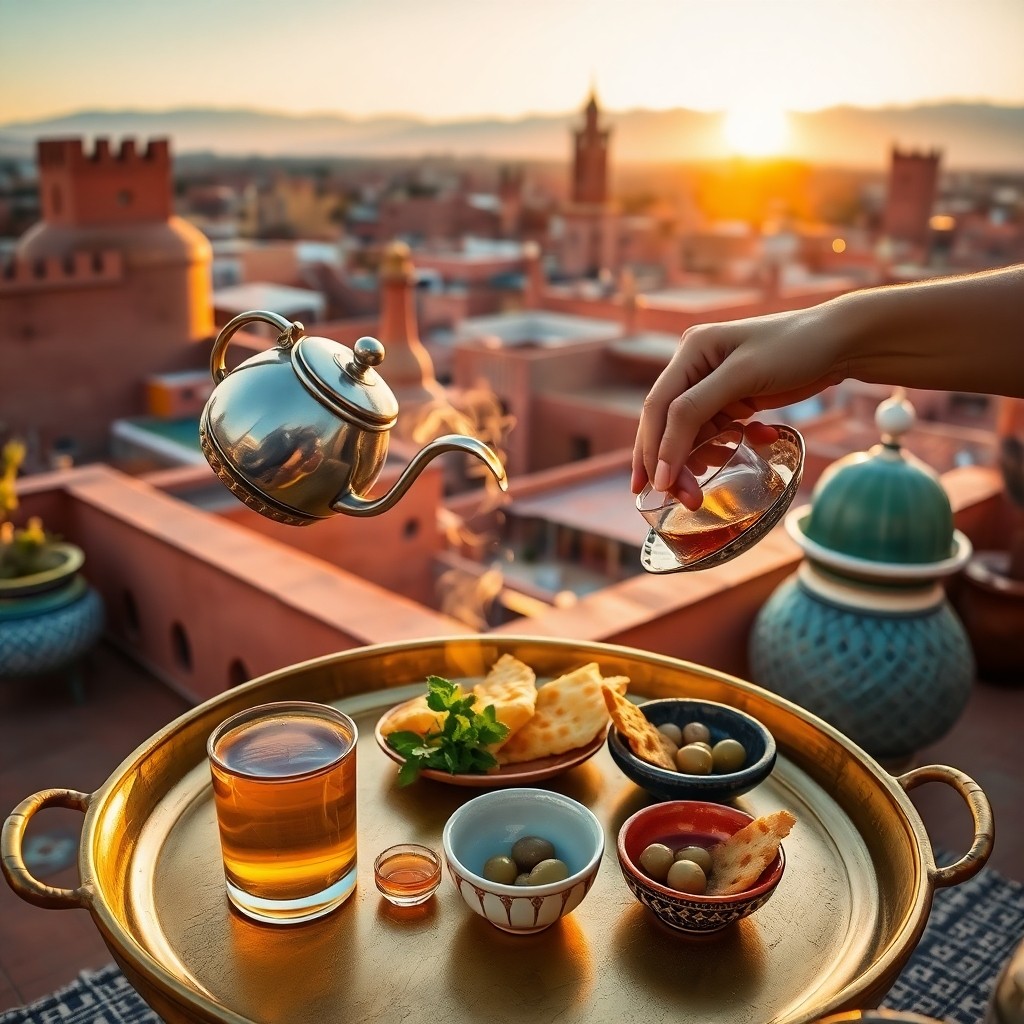
*A serene rooftop breakfast scene capturing the essence of Moroccan morning rituals — mint tea, msemen, and panoramic views of the Red City at dawn.*
A Moroccan morning doesn't begin with an alarm and a sprint to the metro. It begins with tea — specifically, atay bi naana'a, the gunpowder green tea infused with fresh spearmint and generously sweetened with sugar cones. The preparation is itself a ritual: rinse the tea leaves with a splash of boiling water and discard the first bitter wash, add the mint and sugar, then pour from a height to create a thin layer of foam on each glass. The first glass is poured back into the pot. Only the second glass is served. This isn't fussy tradition for its own sake — it's a deliberate deceleration, a way of telling your nervous system that the day will unfold at its own pace.
Alongside the tea comes breakfast: msemen (square, flaky layered flatbreads) drizzled with honey or dipped in olive oil and sprinkled with sesame seeds, or baghrir (semolina pancakes with a thousand tiny holes) soaked in a sauce of melted butter and honey. Amlou — a thick, amber paste made from toasted almonds, argan oil, and wildflower honey — is the spread that ties it all together, and it's a specialty of the Souss region that has found a permanent place on Marrakech tables. Breakfast is not eaten standing over a counter. It's served on a low table, shared with family, and consumed slowly enough that you notice the mint in your tea has a slightly peppery finish.
Contrast this with the average European or American morning — coffee consumed in transit, breakfast reduced to a granola bar — and the difference in quality of life becomes stark. The medina doesn't rush, and neither do the people who live there.
1.2 The Midday Pause and the Evening Unwind
In Morocco, lunch is the anchor meal, typically served between 1:00 and 3:00 p.m., which is notably later than the noon-to-1:00 p.m. window common in Northern Europe. A full Moroccan lunch might include a tagine or couscous, multiple salads (zaalouk — smoked eggplant and tomato — is a staple), fresh bread, and fruit for dessert. After eating, especially during the summer months when temperatures in Marrakech regularly exceed 40°C (104°F), there's a cultural expectation of rest. Shops in the medina close between roughly 1:00 and 4:00 p.m. Workers go home. The streets empty. The city exhales.
This afternoon lull isn't laziness — it's an intelligent adaptation to climate and a reflection of a culture that values human comfort over commercial productivity. When the shops reopen in the late afternoon, the energy shifts. Rooftop terraces fill with families and friends sharing tea and conversation as the sun drops behind the Koutoubia Mosque. Children play in the Jemaa el-Fnaa square, where by 6:00 p.m. the famous night market begins its transformation: food stalls fire up their grills, smoke carries the scent of merguez sausages and grilled sardines, and the square becomes a sprawling open-air restaurant that feeds thousands every night. Dinner in Morocco is often lighter than lunch — harira soup, perhaps, with dates and milk, or simply bread with cheese and olives — but it's always social.
*An intimate view of Moroccan interior design — tadelakt plaster, zellige tilework, and handcrafted brass lanterns that define the aesthetic of the Red City.*
2. The Soul of Moroccan Cuisine: More Than Tagine
2.1 Beyond the Tagine — A Regional Flavor Map
The tagine gets all the press, but reducing Moroccan cuisine to that single dish is like reducing Italian food to pizza. Marrakech, sitting at the crossroads of the Atlas Mountains, the Sahara, and the Atlantic coast, has developed a culinary identity distinct from other Moroccan cities. Fez is known for its refined, courtly dishes heavy with almonds and prunes. Essaouira leans into fresh seafood. The Atlas Berber communities favor hearty breads baked in sand and simple grain-based stews.
Marrakech's signature dishes tell the story of a city that has always been a meeting point. Tanjia Marrakchia is perhaps the most iconic: a clay pot (also called a tanjia) filled with beef or lamb preserved in lemon, garlic, cumin, and smen (fermented butter), then slow-cooked for hours in the embers of a hammam fire. It's traditionally a dish made by men, prepared on a Friday afternoon, and eaten after Friday prayers. Couscous el Marrakchi differs from the standard Friday couscous by incorporating tfaya — a caramelized onion and raisin compote — and is often served with a separate bowl of sweetened milk on the side.
Five must-try Marrakech-specific dishes include: (1) Tanjia Marrakchia, described above; (2) Mechoui — whole lamb slow-roasted in an underground clay oven until the meat falls from the bone; (3) Bissara — a thick, warming soup of dried fava beans served with cumin and olive oil, eaten as a winter breakfast in the souk; (4) Sfenj — Moroccan doughnuts sold fresh from street vendors, best eaten within minutes of frying; and (5) Brochettes de Kefta — spiced ground lamb or beef skewers grilled over charcoal and served with harissa and bread at stalls throughout Jemaa el-Fnaa.
2.2 The Communal Table: Eating as a Social Contract
Eating in Morocco is not a solo activity. When you sit down to a Moroccan meal, you're entering a social contract governed by centuries of tradition. The food is placed in the center — one large tagine or a communal platter of couscous — and everyone eats from the same dish, using pieces of khobz (round Moroccan bread) as your utensil. The proper technique: tear off a piece of bread with your right hand (never the left, which is considered unclean in Islamic tradition), use it to scoop the food from the section of the dish closest to you, and eat it in one or two bites. Reaching across the dish or into someone else's zone is a faux pas.
The host's role is to watch your plate — or rather, the communal dish — and ensure you're eating enough. They'll press more food toward you, lift the best pieces of meat in your direction, and ask "shhal?" (how much?) with genuine concern if you slow down saying you're full. Refusing food repeatedly is not polite self-restraint; it's a rejection of generosity. The concept of dyafa — hospitality — means that a guest is a blessing, and the host is duty-bound to feed you until you physically cannot eat another bite.
For visitors, the etiquette is straightforward: wash your hands before the meal (often a host will bring a basin and soap), accept at least a small portion of whatever is offered, compliment the food sincerely, and leave a little food on the communal dish when you're finished — finishing everything signals the host didn't prepare enough, which is an embarrassment for them.
3. Moroccan Design and Architecture: Living Inside the Aesthetic
3.1 The Riad: A Philosophy of Inward Living
The riad — a traditional Moroccan house built around a central courtyard garden — is one of the most elegant architectural concepts in the world, and it encodes a worldview. Exterior walls are plain, windowless, and fortress-like, offering nothing to the street. But step through the heavy wooden door and you enter a different universe: a courtyard open to the sky, often with a fountain, citrus trees, and four symmetrical garden quadrants inspired by the Islamic concept of paradise (the word "riad" itself means "garden" in Arabic). Rooms open inward, not outward. Privacy isn't an afterthought — it's the organizing principle of the entire structure.
The materials carry meaning. Zellige — the hand-cut geometric tile mosaic that covers walls and fountains — is assembled from individually glazed pieces, each slightly irregular, so that the finished surface catches light differently at every hour. The intentional imperfection is a philosophical statement: only God creates perfection. Carved stucco (tadelakt) and painted cedar wood ceilings add layers of pattern and warmth, while the central courtyard creates natural ventilation — a passive cooling system that keeps riads remarkably comfortable even in Marrakech's brutal summers.
Consider Riad Yasmine, a small guesthouse in the Bab Doukkala neighborhood that has become something of an icon among travelers. Its pool — barely three meters long — is photographed thousands of times a day for social media, but what makes it extraordinary isn't the pool itself. It's the way the space works: the plunge into cool water, the immediate emergence onto warm zellige tile, the glass of tea brought without asking, the absence of anything that demands your attention. That's the riad philosophy distilled — an environment designed to make you present.
3.2 Bringing the Red City Home — Design Principles for Any Space
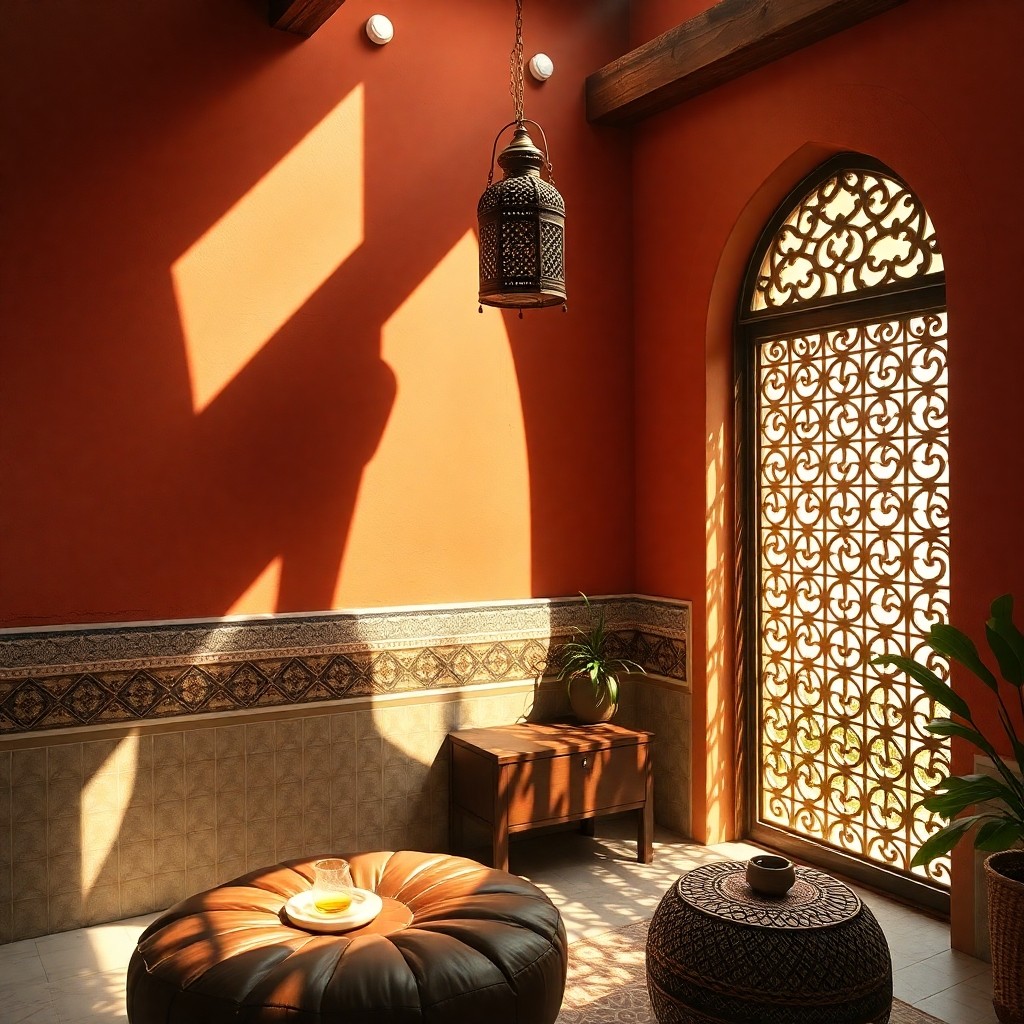
You don't need a riad to absorb Moroccan design principles. The aesthetic translates remarkably well into modern apartments, suburban houses, and even office spaces. The key is understanding that Moroccan design isn't maximalist chaos — it's maximalist *structure*. Patterns exist within strict geometric frameworks. Color is bold but limited to a coherent palette: terracotta, saffron yellow, deep indigo, white, and the dusty pink of Marrakech's famous walls.
Five practical ways to bring this into your home: (1) Replace one overhead light with a pierced metal lantern — the star-shaped shadows it casts on walls at night are transformative. (2) Layer textiles deliberately: a flat-weaven Moroccan boucherouite rug on the floor, a handira (sequined wedding blanket) draped over a sofa, and a few hand-stitched cushion covers in complementary tones. (3) Use negative space aggressively — Moroccan interiors breathe because they aren't cluttered. Choose fewer objects and make each one count. (4) Introduce a single architectural element: a zellige tile backsplash in a kitchen, a carved wooden mirror frame, or an arch-shaped doorway cut into a drywall partition. (5) Embrace terracotta — a painted accent wall, a set of unglazed clay pots, or a tadelakt-finish bathroom surface. The goal isn't to recreate a souk in your living room. It's to borrow the warmth, the tactility, and the sense of sanctuary.
4. Social Customs and the Art of Moroccan Connection
4.1 Dyafa: The Sacred Duty of Hospitality
Dyafa — the Moroccan art of hospitality — is not a social nicety. It's a deeply embedded cultural and religious obligation that traces its roots to both Islamic teachings on honoring guests and ancient Amazigh (Berber) traditions of offering shelter to travelers crossing the desert. In practical terms, dyafa means that a Moroccan host will give you the best chair, the best food, the best tea, and the best portion of their time, often at genuine personal cost. Refusing an invitation to someone's home, when extended sincerely, is mildly offensive. Accepting it — and showing genuine appreciation — bonds you to your host in a way that Western social codes rarely replicate.
When you enter a Moroccan home, you'll be asked to remove your shoes. You'll be seated, and tea will almost certainly be prepared — the famous Moroccan tea ritual involves three glasses, each with a different flavor as the mint and tea leaves steep differently over time. A Moroccan proverb captures this: "The first glass is as bitter as life, the second as strong as love, the third as gentle as death." You should accept at least the first glass. Declining is acceptable only if you have a genuine reason (a caffeine sensitivity, for example), and even then, your host will likely offer an alternative — fresh mint infusion, milk, or coffee.
Gift-giving norms are important: bring something when visiting a home — pastries from a good patisserie, high-quality dates, or a box of Moroccan pastries called "gazelle horns" (kaab el ghazal). Avoid alcohol unless you know your host drinks. Compliment the home, the food, and the host's family — but do so naturally, not performatively. Moroccans have finely tuned radar for insincerity.
4.2 Navigating the Souk: Bargaining as Relationship-Building
Walking into the Marrakech souks for the first time can feel overwhelming — a labyrinth of narrow alleys where vendors call out invitations, the air is thick with the scent of cedar, leather, and spices, and every surface gleams with lanterns, ceramics, and textiles. But haggling here is not a zero-sum game. It's a conversation, and approaching it with respect and good humor will get you better prices and a more enjoyable experience.
The framework is straightforward: when you see something you like, ask the price. The vendor will name a figure — often three to five times what they expect to receive. Offer roughly 30-40% of the asking price. Both sides then negotiate toward a middle ground, usually settling at around 50-60% of the original ask. The key is to keep it light. Smile. Ask about the craft. Compliment the item genuinely. If the vendor tells you a story about how the piece was made, listen — that's part of what you're paying for. If you reach a price that isn't right for you, say "barak Allahou fik" (God bless you) and walk away. Nine times out of ten, the vendor will call you back with a better offer. If they don't, the price was firm, and that's fine too.
Never open with your best price. Never insult the merchandise to drive the price down. And never begin negotiating on something you have no intention of buying. The souk economy runs on trust, and Moroccans remember faces.
5. Wellness and Slow Living: Ancient Traditions for Modern Life
5.1 The Hammam: Cleansing as Community Ritual
The hammam — Morocco's traditional bathhouse — is one of the most transformative wellness experiences available anywhere in the world, and it costs as little as 10 Moroccan dirhams (roughly $1 USD) at a neighborhood public bath. Unlike a spa, which frames bathing as individual pampering, the hammam is communal. Women go to the women's hammam, men to the men's, and what happens there is part hygiene, part social gathering, part spiritual cleansing.
The process follows a specific sequence. First, you enter the warm room — a steam-filled chamber with marble benches and a domed ceiling beaded with condensation — and sit for 10-15 minutes to open your pores. Next, your attendant (or a family member, in a public hammam) applies savon beldi — a dark, olive-oil-based soap with a gel-like consistency — all over your body. It sits for several minutes while the steam does its work. Then comes the kessa: a rough exfoliating glove used to scrub your skin in long, firm strokes. What rolls off your body in grey, rubbery coils is the dead skin you didn't know you had. It's simultaneously horrifying and deeply satisfying. After a thorough rinse, many Moroccans apply ghassoul — a mineral-rich rhassoul clay mixed with water or rose water — as a hair and face mask. The final step is a rinse with cool water and, ideally, a few drops of pure argan oil massaged into damp skin.
For first-timers, a mid-range hammam (150-400 MAD, or $15-40 USD) staffed by professional attendants is the best entry point. Bring your own bucket, kiessa glove, and towel if you're going to a public bath. Wear underwear or a bathing suit — public hammam-goers typically strip to underwear. Don't rush. The whole process takes 60-90 minutes, and the point isn't the cleanliness — it's the surrender.
5.2 Argan, Herbs, and the Moroccan Apothecary
Morocco's landscape is a natural pharmacy, and Moroccan wellness traditions draw on ingredients that have been used for centuries. Argan oil — produced exclusively in southwestern Morocco from the nuts of the argan tree — is the most famous, used both cosmetically (for skin, hair, and nails) and culinary (drizzled over couscous or mixed into amlou). Rose water, harvested during the May rose festival in the town of Kelaat M'Gouna in the Dades Valley, is used to flavor pastries, scent homes, and tone the skin. Amber — in the Moroccan context, a perfume accord rather than the resin — is a warm, musky scent used in both men's and women's fragrances. Saffron from Taliouin adds color and a haunting bittersweet flavor to dishes and is one of the most precious wellness ingredients in Moroccan cooking.
Five Moroccan natural remedies worth knowing: (1) Nigella satoria (black seed, or "habbat al-baraka") — taken with honey for immune support, a remedy referenced in Islamic prophetic tradition. (2) Verbena (louiza) — brewed as a tea for digestive issues and anxiety. (3) Rosemary (yazir) — used in steam inhalations for respiratory congestion. (4) Aloe vera gel — applied directly from the plant for burns and skin irritation, a staple in Moroccan household gardens. (5) Orange flower water (ma zhar) — added to water for a calming, aromatic drink, and used in baking. You can find most of these at herbalistes (herbal medicine shops) throughout the Marrakech souk, where vendors will explain preparation methods and dosages.
6. How to Embrace the Red City Spirit — Even After You Leave
The most valuable thing you can bring home from Marrakech isn't a lantern or a leather pouffes — it's a recalibrated sense of pace. The Moroccan lifestyle teaches that luxury isn't excess; it's presence. It's the willingness to sit with someone for an hour over tea without checking your phone. It's the discipline of eating lunch at lunchtime and resting when the sun is at its peak. It's the generosity of offering your best to a guest, even when your best is modest.
Practically, start small. Adopt a tea ritual — even if you swap gunpowder green tea for whatever you have, the act of preparing it slowly and serving it to someone else changes the texture of your day. Prioritize in-person connection over digital communication. Slow your eating. Cook a tagine on a Sunday afternoon and let it simmer for three hours while you do nothing else.
If you want to source authentic Moroccan goods ethically, look for cooperatives and fair-trade organizations that ensure artisans are paid fairly. Those seeking authentic Moroccan home goods can explore curated collections that celebrate traditional craftsmanship. For those interested in Moroccan beauty essentials, there are excellent resources for natural skincare rooted in Moroccan traditions. A standout product is this organic Moroccan black soap, which offers an authentic hammam experience at home. Tea enthusiasts will love this handcrafted Moroccan teapot, perfect for preparing traditional mint tea.
Conclusion
The Moroccan lifestyle, at its core, is a philosophy of warmth — warmth of color, of flavor, of human connection, of pace. Marrakech, the Red City, distills this philosophy into its most vivid form: a place where the architecture glows amber at sunset, where a stranger's kitchen is your kitchen, where the afternoon belongs to rest and the night belongs to gathering. But you don't need a plane ticket to live this way. You need only the willingness to slow down, to eat with your hands, to offer your chair to someone else, and to pour tea with intention. The spirit of the Red City isn't a postcard — it's a practice.
The Moroccan writer Tahar Ben Jelloun once wrote, "To be alive is to be a guest of the world." Morocco understood this long before the rest of us started searching for it. Share your own Moroccan moments in the comments — a meal, a conversation, a hammam, a dawn on a rooftop — or start planning your own journey to the Red City. The tea is already steeping.
FAQ Section
**Q1: Why is Marrakech called the Red City?**
Marrakech is called the Red City because of the distinctive red sandstone and clay used in its walls, ramparts, and buildings. This architectural tradition dates back to the 12th-century Almoravid dynasty and has been maintained by municipal regulations that require new construction within the medina to use the same ochre-toned materials.
**Q2: What is a typical day like in Marrakech?**
A typical day in Marrakech begins early with the dawn call to prayer and a slow breakfast of mint tea and msemen. Shops open in the morning, close for the midday meal and afternoon rest (roughly 1:00–4:00 p.m.), then reopen in the late afternoon. Families gather on rooftops at sunset, and the Jemaa el-Fnaa square transforms into a massive night market with food stalls, musicians, and storytellers after dark.
**Q3: What should you not do when visiting a Moroccan home?**
Avoid these key etiquette mistakes: refusing tea when offered (accept at least one glass), using your left hand to eat or pass items, entering with your shoes on, declining food without a genuine reason, and rushing through the visit. Also avoid bringing alcohol unless you know your host drinks.
**Q4: How much should you pay for a hammam in Marrakech?**
A public neighborhood hammam costs 10–30 MAD ($1–3 USD). A mid-range hammam with professional attendants and amenities runs 150–400 MAD ($15–40 USD). Luxury spa hammams at high-end hotels and resorts start at 500+ MAD ($50+ USD) and may include additional treatments like massages and facials. For a first visit, a mid-range option offers the best balance of authenticity and comfort.
**Q5: What makes Moroccan hospitality unique?**
Moroccan hospitality (dyafa) is rooted in both Islamic teachings on honoring guests and ancient Amazigh traditions of desert hospitality. It manifests as an almost sacred obligation to feed, shelter, and prioritize guests above all else — even at personal cost. Unlike transactional Western hospitality, dyafa is unconditional: a stranger is treated like family from the moment they arrive.
**Meta Description:** Discover the Moroccan lifestyle through the lens of Marrakech — daily rituals, cuisine, design, hammam traditions, and the art of slow living in the Red City.