
Moroccan Lifestyle: Embracing The Rhythm Of The Desert
Moroccan Lifestyle: Embracing the Rhythm of the Desert
The first light of dawn spills over the Erg Chebbi dunes, and the silence is broken only by the muezzin's call rolling across the Sahara like a wave. In a guesthouse in Merzouga, a silver teapot arcs a thin stream of amber mint tea into a glass already fragrant with fresh spearmint. The sugar cubes sit in a wooden box carved by hand. Nothing is rushed. Nothing is accidental. This is the **Moroccan lifestyle** — not a postcard image, but a living philosophy shaped by centuries of desert living traditions, where every gesture, meal, and architectural curve carries the memory of an unforgiving landscape.
What makes this lifestyle remarkable is its reach. Customs born in the Sahara's extreme heat and isolation have migrated into the medinas of Fes, the coastal cafés of Essaouira, and the modern apartments of Rabat. They live in the way Moroccans build homes, eat meals, welcome strangers, and mark time. Understanding this rhythm offers something rare in an accelerated world: a proven framework for intentional living, rooted in patience, sensory richness, and communal care.
1. The Desert as a Teacher: How the Sahara Shaped Moroccan Values### 1.1 Patience, Resilience, and the Art of Slowing Down
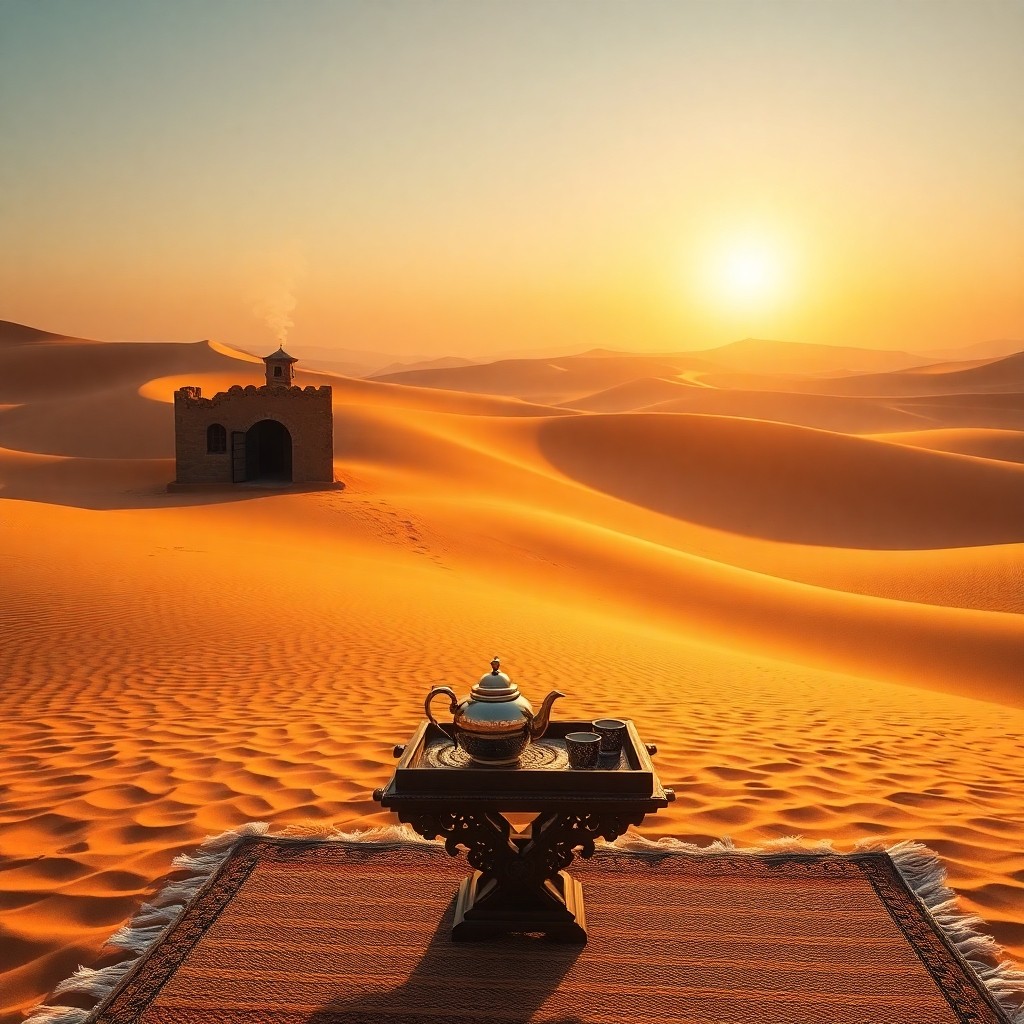
*A cinematic sunrise scene capturing the quiet ritual of Moroccan mint tea at a traditional guesthouse on the edge of the Sahara Desert, embodying the patience and intentionality of Moroccan desert living.*
The Sahara does not reward haste. Temperatures swing from scorching days to near-freezing nights. Water sources shift with the seasons. For the Amazigh (Berber) nomadic groups who traversed these expanses for millennia, survival depended on *sabr* — a concept that translates as patience but encompasses endurance, foresight, and the wisdom to act only when conditions are right. Ethnographic accounts of Saharan nomadic life, including studies documented by the Royal Institute for Amazigh Culture (IRCAM), describe how Tuareg and Amazigh communities developed elaborate systems of mutual aid, where sharing water and food was not charity but a calculated investment in collective survival.
This desert-born patience surfaces in the modern Moroccan relationship with time. The phrase *"inshallah"* and the casual *"demain"* (tomorrow) are not signs of unreliability — they reflect a worldview that prioritizes human connection over mechanical scheduling. When a Moroccan friend says they will come tomorrow, they mean it sincerely, but they also mean that the relationship matters more than the clock. This is not procrastination. It is a cultural inheritance from an environment where forcing the pace could mean death.
1.2 Hospitality as Survival — Why Guests Are Sacred
In the desert, a stranger appearing on the horizon was not a threat to be feared but a life to be preserved. Dehydration and exposure kill within hours. Offering water, food, and shelter to a traveler was a non-negotiable moral code — and a practical one, because today's host could be tomorrow's stranded wanderer. This survival logic evolved into one of the most celebrated features of Moroccan culture: hospitality so generous it can unsettle visitors accustomed to transactional social norms.
The three-glass tea ceremony crystallizes this ethos. The first glass is "gentle as life," the second "strong as love," and the third "bitter as death." Each pour from a height of twelve inches or more aerates the gunpowder green tea and fresh mint, creating a frothy head. Refusing any of the three glasses is considered impolite — not because of rigid etiquette, but because accepting all three signals trust and mutual respect. In urban homes from Casablanca to Tangier, this ritual persists unchanged. A guest who arrives unannounced will still be seated, fed, and served tea before any business is discussed. The desert's survival code has become a city's social contract.
Moroccan artisans have perfected the craft of tea service over generations. A handmade Moroccan tea pot set carries the same spirit of intentional craftsmanship — each piece hand-carved in Fes, reflecting the geometric artistry and cultural pride that define Moroccan hospitality.
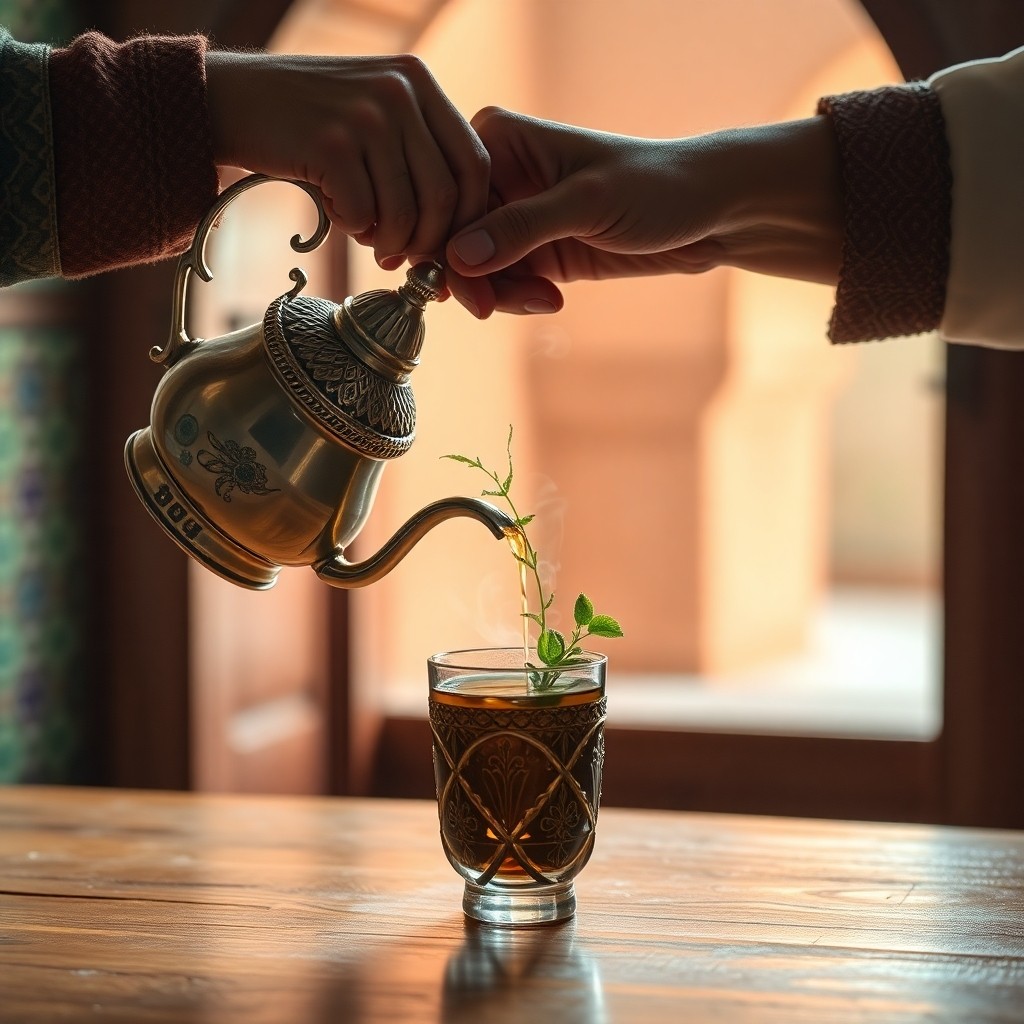
*An intimate close-up of the iconic Moroccan tea ceremony, highlighting the craftsmanship of the silver teapot and the sensory richness central to Moroccan hospitality and communal care.*
2. The Architecture of Cool: Desert-Inspired Design in Everyday Moroccan Life### 2.1 Riads, Courtyards, and the Science of Passive Cooling
Step through the unassuming wooden door of a traditional Moroccan riad in the Marrakech medina, and the temperature drops noticeably. This is not air conditioning — it is engineering refined over centuries. The riad's central open-air courtyard, often planted with orange trees and fitted with a small fountain, functions as a thermal chimney. Hot air rises and escapes through the opening at the top, drawing cooler air from the thick earthen walls below. Walls built from rammed earth (*pisé*) or adobe absorb heat during the day and release it slowly at night, stabilizing interior temperatures.
Research on traditional Moroccan construction has shown that interior temperatures in well-maintained riads can remain 10–15°C cooler than exterior readings during peak summer heat, without any mechanical cooling. The inward-facing design — windows opening onto the courtyard rather than the street — serves triple duty: it creates natural cooling, ensures family privacy in a culture that values modesty, and establishes a private sanctuary for spiritual reflection. The home turns inward, away from the chaos of the outside world, creating a microclimate of calm.
2.2 Zellige, Carved Plaster, and the Geometry of Meditation
Look closely at the walls of a traditional Moroccan home, and you will find surfaces that reward sustained attention. Zellige tilework — geometric mosaics assembled from individually hand-chiseled ceramic pieces — covers fountains, walls, and floors in patterns that seem to extend infinitely. Each tile is cut by hand using a sharp hammer-like tool called a *menqach*, then fitted into place without mortar, relying on precise angles and a gypsum-based backing to hold the composition together. A single square meter of complex zellige can take a skilled artisan several days to complete.
Carved stucco (*gebs*) fills arches and upper walls with arabesques and geometric stars that dissolve into one another. These patterns are not merely decorative. In Islamic artistic tradition, the repetition of geometric forms without a clear beginning or end reflects the infinite nature of creation — a concept that resonates deeply with the desert dweller's experience of endless sand and sky. Sitting in a room adorned with zellige, the eye follows a pattern that never resolves, inducing a meditative state. The architecture itself becomes a tool for contemplation, a built environment designed to slow the mind the way the desert slows the body.
3. A Culinary Clock: How Desert Rhythms Define What and When Moroccans Eat### 3.1 The Tagine as Time Machine — Slow Cooking for Hot Days
The tagine — both the conical clay pot and the stew cooked inside it — is a masterpiece of desert engineering. The cone-shaped lid traps steam, condenses it, and returns moisture to the dish, allowing food to cook with minimal water. In a region where water is precious, this design is not a quirk but a necessity. A lamb tagine with prunes and almonds, or a chicken tagine with preserved lemons and olives, can simmer for two to three hours over low charcoal heat, transforming tough cuts into tender, deeply flavored meals without drying out.
Regional variations tell the story of Morocco's geography. In the Saharan south, tagines incorporate dried meat (*khlea*), dates, and camel milk — ingredients that store well in extreme heat. Along the Atlantic coast, seafood tagines with chermoula marinade and fresh sardines dominate. The cultural rule of eating the largest meal at midday, rather than in the evening, is a direct adaptation to desert labor cycles. Workers need fuel during the hottest part of the day, and a heavy meal at night in poorly ventilated homes would be uncomfortable. This midday feast — often a communal affair with bread used as the primary utensil — remains standard practice even in air-conditioned modern offices.
3.2 Ramadan Under the Desert Moon: Fasting as Communal Rhythm
During Ramadan, the Moroccan lifestyle reveals its deepest communal architecture. The entire country shifts its rhythm to accommodate the fast from dawn to sunset. Offices shorten hours. Shops close in the afternoon and reopen after *ftor* (the breaking of fast). The meal itself is a synchronized city-wide event: at the exact moment of sunset, millions of Moroccans break their fast with dates, harira soup, and chebakia honey pastries simultaneously.
Historically, the *nafar* — a town crier dressed in a traditional gandora and slippers — walked through neighborhoods blowing a horn to wake families for *suhoor*, the pre-dawn meal. While loudspeakers and smartphone alarms have largely replaced the nafar, the function remains the same: ensuring no one fasts alone. The desert lesson of endurance and gratitude for scarce resources is rehearsed every day of Ramadan. When water has been absent from your lips for fourteen hours, the first sip is not routine — it is revelation. This annual practice reinforces the desert-born awareness that sustenance is not guaranteed, and that sharing it is the highest form of community.
4. The Social Sahara: Music, Storytelling, and Gathering as Cultural Anchors### 4.1 Gnawa Music — The Soundtrack of the Desert's Spiritual Memory
Gnawa music carries the memory of the Sahara's crossroads. Originating among sub-Saharan Africans brought north through trans-Saharan trade routes, Gnawa blends Amazigh, Arab, and West African musical traditions into a sound that is unmistakable: the deep, resonant thrum of the *guembri* (a three-stringed bass lute) paired with the metallic clatter of *qraqeb* (iron castanets). A traditional *lila* — a Gnawa spiritual night ceremony — can last eight hours, moving through a sequence of songs that invoke ancestral spirits, each associated with a specific color, incense, and rhythmic pattern.
The *maalem* (master musician) leads the ceremony, and participants enter trance states that function as communal healing. Gnawa is not performance in the Western sense; it is ritual, therapy, and historical memory compressed into sound. Today, the annual Gnawa World Music Festival in Essaouira draws international audiences, but the music's roots remain firmly planted in the desert's spiritual soil — a reminder that the Moroccan lifestyle is not monolithic but a layered accumulation of diverse desert cultures.
4.2 The Majlis Tradition — Why Moroccans Still Sit Together on the Floor
In a traditional Moroccan *majlis*, guests sit on floor cushions arranged in a circle or U-shape around a low table. There are no head seats, no hierarchies of height. This arrangement descends directly from Bedouin tent culture, where the circular gathering ensured every person could see and hear every other person, and where the host served tea from the center outward. The floor-level seating eliminates the power dynamics embedded in Western dining — the person at the head of the table, the elevated chair, the physical distance between host and guest.
This tradition resists the digital isolation that characterizes much of modern life. In a majlis, phones are set aside. Stories are told aloud. Elders pass down oral histories, jokes, and proverbs that would never survive in a text message. The physical closeness — knees nearly touching, hands sharing a communal plate — reinforces the desert principle that survival and meaning depend on proximity to others. You cannot be alone in a circle.
5. Bringing the Desert Home: Practical Lessons from the Moroccan Lifestyle### 5.1 Five Daily Habits Rooted in Desert Wisdom
You do not need a plane ticket to absorb the Moroccan lifestyle. These five habits, each with a clear desert origin, can be adopted immediately:
1. **Pour tea with intention.** The act of pouring mint tea from a height, waiting for the foam to form, and serving others before yourself is a daily practice in mindfulness and generosity. Replace your rushed coffee ritual with a five-minute tea ceremony.
2. **Eat your largest meal at midday.** Shift your heaviest caloric intake to lunch, as Moroccans do. Your body will process food more efficiently, and you will avoid the sluggishness of a heavy dinner in a warm house.
3. **Create a courtyard-like calm space at home.** You do not need an open-air courtyard. Designate one room or corner with minimal furniture, a water feature (even a small tabletop fountain), and natural materials to serve as your inward-facing sanctuary.
4. **Practice the three-glass ritual with loved ones.** When you serve tea or any drink to guests, commit to three rounds. The ritual slows the interaction and signals that the relationship matters more than the transaction.
5. **End each day with communal conversation.** Replace thirty minutes of screen time with face-to-face conversation. Sit at the same level, share food, and let the conversation wander without an agenda.
5.2 Designing a Moroccan-Inspired Sanctuary
Transforming your living space to reflect Moroccan design principles does not require a renovation. Start with a palette of earth tones — terracotta, sand, ochre, and white — drawn directly from the Sahara's palette. Incorporate handmade ceramics from artisan cooperatives in Safi, where potters have worked the same clay for centuries. Add a zellige-style tile accent on a kitchen backsplash or bathroom wall. Choose textiles woven by Amazigh women's cooperatives in the High Atlas — their rugs carry geometric patterns that encode personal and tribal stories.
Prioritize a central gathering space. Arrange seating in a circle, not a row. Remove the television from the primary social room. Add a small fountain or even a bowl of water with floating petals — the sound of water is a desert luxury that signals life and abundance. These changes are not aesthetic indulgences; they are environmental cues that tell your nervous system to slow down, connect, and breathe.
For those seeking authentic Moroccan beauty products inspired by traditional ingredients like argan oil and rose water, the heritage of Moroccan self-care is a living extension of these desert traditions. And a wider collection of handcrafted Moroccan artisan goods — from carved wooden boxes to handwoven baskets — can help bring that same artisanal warmth into your daily spaces.
Conclusion
The Moroccan lifestyle is not a museum exhibit. It is a refined, adaptive response to one of the harshest environments on Earth — a system of values, designs, and rituals that turns scarcity into generosity, heat into coolness, and isolation into community. Embracing the rhythm of the desert means recognizing that slowness is not laziness, that hospitality is not performance, and that the spaces we inhabit shape the lives we lead.
You do not need to live in the Sahara to benefit from these lessons. The desert's rhythm is available wherever you are — in the way you pour a glass of tea, arrange your furniture, or greet a stranger. Start with one habit. Build one sanctuary. Share one meal at midday with someone who matters. The dunes have been teaching these lessons for millennia. All that remains is to listen.
Frequently Asked Questions (FAQ)
**Q1: What makes Moroccan culture unique compared to other North African cultures?**
Moroccan culture sits at a rare intersection of Amazigh (Berber), Arab, Saharan, and Mediterranean influences. Morocco is home to over 37 million people who speak a blend of Arabic, Tamazight (Berber), French, and Spanish, creating a cultural blend found nowhere else in North Africa. This diversity is visible in everything from architecture to music to cuisine.
**Q2: How does the desert influence daily life in Morocco today?**
Even urban Moroccans maintain desert-rooted customs in their food (tagine cooking, midday feasts), architecture (inward-facing homes, thick earthen walls), social rituals (mint tea ceremonies, majlis gatherings), and attitudes toward time and hospitality. The desert is not a distant memory — it is an active cultural force.
**Q3: What is a Moroccan riad and why is it designed the way it is?**
A riad is a traditional Moroccan house built around a central interior courtyard. The design serves desert survival: the courtyard acts as a natural cooling chimney, thick earthen walls regulate temperature, and inward-facing windows ensure privacy and protection from heat and dust.
**Q4: Why is mint tea so important in Moroccan culture?**
Mint tea is the primary vehicle of Moroccan hospitality. The three-glass ceremony symbolizes the progression of a relationship — from gentle acquaintance to deep connection. Refusing tea is rare; accepting it signals trust and mutual respect, a tradition rooted in the desert code of welcoming strangers.
**Q5: Can I incorporate Moroccan lifestyle principles into my own home?**
Absolutely. Start with three immediately actionable habits: adopt the tea ritual with guests, create a central gathering space arranged in a circle, and shift your largest meal to midday. Add earth tones, handmade ceramics, and a water feature to bring desert-inspired calm into your daily environment. Authentic Moroccan exfoliating mitts are another easy way to bring a touch of traditional self-care into your routine — perfect for a weekly grooming ritual.
**Meta Description:** Discover how the Moroccan lifestyle — shaped by Sahara desert traditions — offers timeless lessons in mindful living, hospitality, architecture, and intentional design.