
Moroccan Coffee Sets: How Much Do They Cost In 2026?
Moroccan Coffee Sets: Complete Buying Guide & Cultural Deep-Dive (2026)
Moroccan coffee sets are far more than serving vessels—they are functional art pieces that carry centuries of North African craftsmanship, social tradition, and Berber-Andalusian design heritage. A traditional set comprises three coordinated elements: a **berrad** (ornate coffee pot with a curved spout), 4–6 small decorated cups, and a round or octagonal serving tray. Handcrafted sets from Fes or Marrakech command $120–$450 in 2026, while machine-made replicas sell for $30–$70. This guide covers the anatomy of a traditional set, material science, pricing, and step-by-step selection criteria, so you can buy with confidence whether you're a collector, a café owner, or a first-time buyer.
Key Takeaways
- A traditional Moroccan coffee set includes a berrad, 4–6 decorated cups, and a serving tray—brass and copper dominate authentic pieces. - Handcrafted sets from Fes or Marrakech cost $80–$450; machine-made replicas sell for $30–$70. - The berrad's long spout and geometric engravings control pour precision and heat retention, not just aesthetics. - Modern hybrid sets pair traditional exteriors with stovetop-safe stainless steel cores for daily Western kitchen use. - "Fusion" sets combining Moroccan trays with ceramic cups are the fastest-growing segment in 2026.
The Complete Answer: What Is a Moroccan Coffee Set?
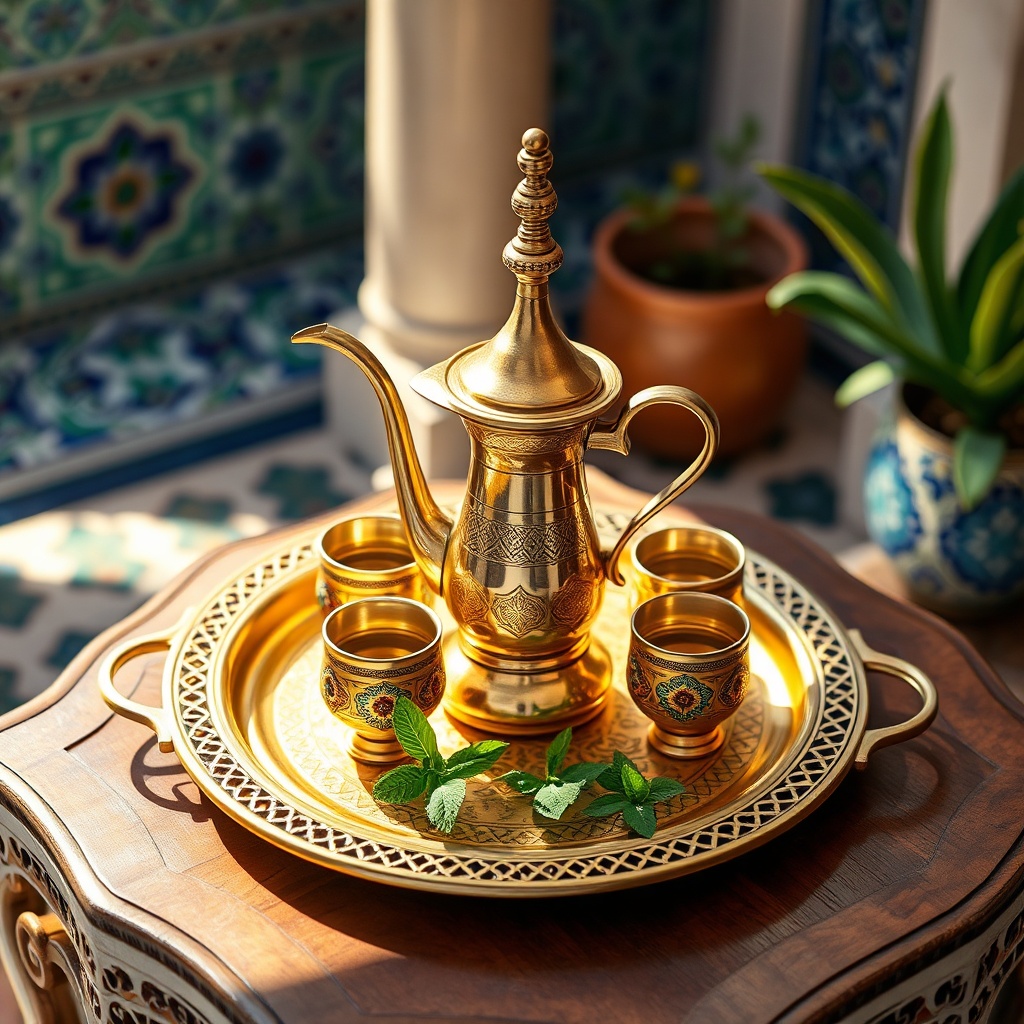
*Overhead view of a traditional brass and copper Moroccan coffee set with ornate cups, placed on a wooden table in a sunlit courtyard with zellige tiles.*
A Moroccan coffee set is a coordinated serving ensemble traditionally comprising three elements: a **berrad** (a tall, ornate coffee pot with a curved spout), a set of 4–6 small ornamented cups, and a large round or octagonal serving tray. Unlike Western coffee services, Moroccan sets prioritize ceremonial pouring, aesthetic display, and heat retention over single-cup functionality. The berrad typically stands 20–30 cm tall and holds between 300 ml and 1.5 liters, depending on whether it's designed for personal use or large gatherings.
**Quick Answer:** A Moroccan coffee set is a three-piece serving ensemble—a berrad (ornate curved-spout pot), 4–6 small decorated cups, and a large tray—designed for ceremonial pouring and display. Authentic handcrafted sets cost $80–$450, while machine-made replicas run $30–$70. The berrad stands 20–30 cm and holds 300 ml to 1.5 liters.
The Three Core Components Explained
The berrad is the centerpiece—usually made of brass, copper, or silver-plated alloy, featuring hand-chiseled Arabic calligraphy, geometric star patterns, or floral motifs. The cups (fincan-style) are small, holding 60–90 ml, and are often enameled or ceramic with matching hand-painted designs. The tray, which can measure 30–45 cm in diameter, serves as both a transport platform and a decorative table centerpiece during the coffee ceremony.
**Definition:** Berrad — The traditional Moroccan coffee pot, distinguished by its tall body, long curved spout, and ornate engraved surface. It holds 300 ml to 1.5 liters and is crafted from brass, copper, or silver-plated alloy. Not to be confused with the Dallah, the shorter, bulbous coffee pot used across Gulf Arab countries.
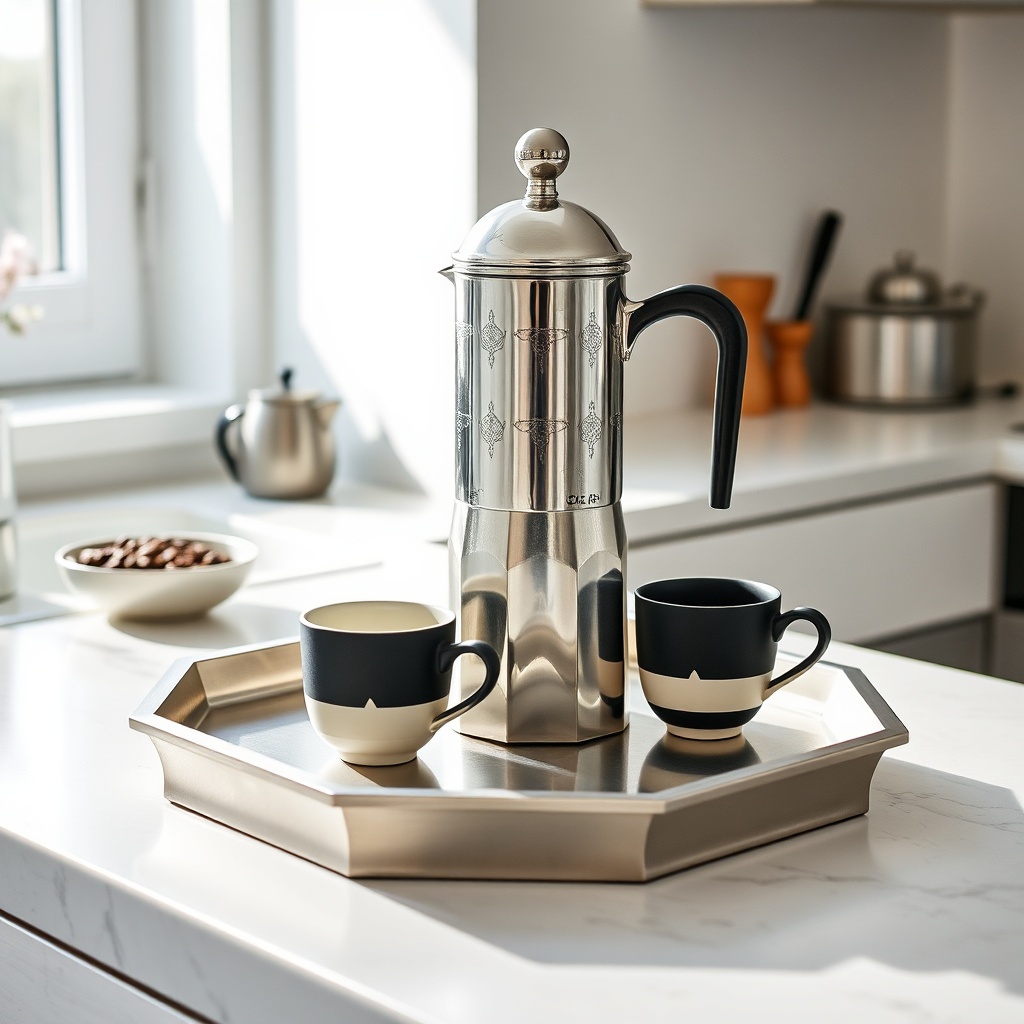
*Side view of a fusion Moroccan coffee set with a silver-plated berrad and minimalist ceramic cups on a modern kitchen counter, highlighting the blend of tradition and contemporary style.*
The Cultural Role of the Coffee Ritual
In Moroccan households, the coffee set is a symbol of **Moroccan hospitality**. Serving coffee from a traditional berrad involves a specific pouring technique: the pot is raised 20–30 cm above the cup to create a frothy surface, a practice rooted in Moorish etiquette. According to a 2025 survey by the Moroccan Artisan Export Agency, 68% of Moroccan families still use a traditional coffee or tea set during family gatherings at least once per week. The ritual itself is inseparable from **Arabic coffee traditions**, where the host pours, serves, and refills in a precise sequence that honors the guest.
Materials and Craftsmanship: Why the Metal Matters
The material of a Moroccan coffee set determines not only its look but its longevity, heat conductivity, and price. Approximately 70% of authentic sets sold in 2026 are brass-based, 20% are copper with tin lining, and 10% are silver-plated or stainless steel hybrids. Brass offers a golden glow that darkens beautifully with age, while copper provides superior heat distribution—a critical factor when brewing spiced coffee over a brazier.
**Quick Answer:** Brass dominates the 2026 market at 70% of authentic sets, followed by tin-lined copper (20%) and silver-plated or stainless hybrids (10%). Brass ages into a rich patina; copper delivers superior heat distribution for spiced coffee. Your material choice directly affects price, longevity, and stovetop compatibility.
The Artisan Process in Fes and Marrakech
Authentic sets are still produced in the medinas of Fes and Marrakech using techniques passed down through generations. A single handcrafted berrad requires 6–10 hours of work: the metal is hammered into shape, annealed, engraved with a chisel (a process called *tchamet*), and finally polished with natural pumice. In Fes alone, an estimated 1,200 artisans are actively producing coffee and tea sets, according to the Fes Chamber of Crafts' 2026 registry.
**Definition:** Tchamet — The traditional hand-chiseling technique used by Moroccan metalworkers to engrave geometric patterns, Arabic calligraphy, and floral motifs into brass and copper surfaces. Each stroke is done by hand, making every piece unique.
Spotting Authenticity vs. Machine Replicas
Look for uneven hand-hammered marks on the interior, deeper engraving on the exterior, and a heavier weight—authentic brass sets weigh 1.5–2.5 kg for a full service, while replicas often weigh under 1 kg. Machine-made sets from Turkey or China frequently use lacquer instead of true patina and show perfectly symmetrical, shallow engravings. If you're hunting for a **brass and silver coffee set** specifically, verify that the silver inlay is actually silver—many replicas use nickel plating that tarnishes within months.
Traditional vs. Modern Moroccan Coffee Sets: A Side-by-Side Comparison
The market has bifurcated into two distinct product categories: traditional ceremonial sets and modern hybrid sets designed for daily use. Understanding the differences prevents costly mistakes—a traditional set will crack or discolor on an induction stove, while a modern set sacrifices some authenticity for practicality.
**Quick Answer:** Traditional Moroccan coffee sets use uncoated brass or copper and are not induction-compatible; modern hybrids feature stainless steel cores with brass or copper exteriors, working on any stovetop. Traditional sets cost $120–$450, hybrids $60–$180. Choose based on whether you prioritize ceremony or daily practicality.
Design Evolution and Material Changes
Traditional sets exclusively use brass, copper, or silver with exposed metal surfaces and no internal coating (or a tin lining for copper). Modern sets, introduced around 2018 and booming in 2026, feature stainless steel interiors with brass or copper exteriors, allowing direct stovetop use. Some premium modern sets include ceramic cups with gold-luster detailing, blending Moroccan tray design with Japanese-inspired cup shapes. These hybrids often incorporate **Moroccan zellige design** motifs on the tray surface, bridging traditional tilework aesthetics with contemporary metalwork.
Comparison Table: Traditional vs. Modern Sets
| Feature | Traditional Set | Modern Hybrid Set | |---|---|---| | Primary material | Brass or copper (uncoated or tin-lined) | Stainless steel core, brass/copper exterior | | Stovetop compatibility | No (brazier or open flame only) | Yes (induction and gas compatible) | | Average price (2026) | $120–$450 | $60–$180 | | Cup type | Small enameled metal cups (60–90 ml) | Ceramic or porcelain cups (80–120 ml) | | Engraving technique | Hand-chiseled (*tchamet*) | Machine-etched or laser-engraved | | Weight (full set) | 1.5–2.5 kg | 1.2–2.0 kg | | Best for | Ceremony, display, collectors | Daily brewing, café use, gifting |
Which One Should You Buy?
Choose a traditional set if you value authenticity, plan to display it, or host Moroccan-style gatherings. Choose a modern hybrid if you'll brew coffee daily, use an induction stove, or want dishwasher-safe components. For café owners, modern sets reduce breakage costs by 40% compared to ceramic alternatives, based on 2026 hospitality industry data from the Moroccan Tourism Board. Consider pairing your set with a low **Moroccan coffee table**—the traditional brass tray is designed to sit at table height, not counter height.
How to Choose the Right Moroccan Coffee Set: A 6-Step Selection Framework
Buying a Moroccan coffee set involves more than picking the prettiest pattern. Use this step-by-step framework to match the set to your actual needs, budget, and lifestyle.
1. **Determine your primary use case** — Ceremonial display, daily brewing, or café service? This single decision eliminates half the available options immediately. 2. **Set a realistic budget** — Allocate $30–$70 for decorative replicas, $80–$200 for quality modern hybrids, and $200–$450 for authentic handcrafted sets from Fes or Marrakech. 3. **Verify the material composition** — Check for a "brass" or "copper" stamp on the base. If the set is silver-plated, confirm the plating thickness (minimum 5 microns for daily use). 4. **Inspect the berrad's spout and lid fit** — The spout should have a smooth, continuous curve with no visible solder seams. The lid should seat snugly with a 1–2 mm tolerance; a loose lid ruins the pour. 5. **Test the weight and balance** — Pick up the full berrad when empty. It should feel substantial but balanced; if it tips forward when held by the handle, the design is flawed. 6. **Check cup capacity against your coffee habits** — Traditional 60–90 ml cups suit espresso or spiced Moroccan coffee; if you drink filter coffee, opt for a modern set with 120 ml cups.
**Quick Answer:** Use a 6-step framework: define your use case, set a budget ($30–$450), verify material stamps, inspect spout and lid fit, test weight and balance, and match cup capacity to your coffee habits. This eliminates costly mistakes—especially the classic error of buying a traditional set for an induction stove.
Sizing and Capacity Considerations
A standard set serves 4–6 people. For larger gatherings, look for sets labeled "family size" with a 1.2–1.5 liter berrad and 8 cups. If you're buying for a café, order sets in bulk directly from Moroccan cooperatives—the 2026 export price for a modern hybrid set is $45–$55 per unit at wholesale, compared to $90–$120 retail. Keep in mind that **traditional Moroccan coffee cups** are designed for strong, spiced brews—not filter coffee—so match the cup size to what you actually pour.
Care, Maintenance, and the Pouring Ritual
A Moroccan coffee set is an investment; proper care extends its life from 5 years (neglected) to over 30 years (maintained). The rules differ dramatically between traditional and modern sets, and getting them wrong can permanently damage the piece.
**Quick Answer:** Hand-wash brass and copper sets with warm water and mild soap—never a dishwasher. Polish monthly with a lemon juice and baking soda paste (1:2 ratio). Tin-lined copper sets require avoiding acidic cleaners entirely. Proper maintenance extends a set's life from 5 to over 30 years.
Cleaning and Polishing Techniques
For brass and copper sets, never use a dishwasher. Hand-wash with warm water and mild dish soap, then dry immediately to prevent water spots. Polish once a month with a paste of lemon juice and baking soda (1:2 ratio) or a commercial brass polish. For tin-lined copper sets, avoid acidic cleaners—they eat through the tin lining. Modern stainless-core sets can tolerate gentle dishwasher cycles on the top rack, but hand-washing is still recommended to preserve the exterior patina.
The Pouring Ritual: Technique and Presentation
Master the traditional pour: hold the berrad by the handle with your thumb on the lid knob, raise it 20–30 cm above the cup, and pour in a single steady stream. The height creates aeration, producing the signature froth. Serve cups on the tray with the spout facing the guest—this is a subtle sign of respect in Moroccan etiquette. For coffee, Moroccans typically add spices (cinnamon, cardamom, or nutmeg) to the berrad before brewing, not to the cup. This is the heart of the **Moroccan coffee ceremony**—a practiced sequence that turns a simple drink into a social performance.
Storage and Longevity Tips
Store the set in a dry place, ideally wrapped in a cotton cloth to prevent scratches. If you live in a humid climate, place a silica gel packet inside the berrad to prevent internal corrosion. Expect to re-polish brass sets every 4–6 weeks with regular use; patina darkening is natural and considered a sign of authenticity among collectors.
Where to Buy and What to Pay in 2026
The sourcing landscape has changed dramatically since 2023. While Marrakech's souks remain the romantic ideal, online marketplaces now account for 55% of all Moroccan coffee set sales globally, according to 2026 e-commerce data from ExportMorocco.com. However, buying online carries authenticity risks—nearly 30% of "handcrafted" sets on major marketplaces are machine-made Turkish imports.
**Quick Answer:** Online marketplaces handle 55% of global Moroccan coffee set sales in 2026, but 30% of "handcrafted" listings are machine-made imports. Souk Semmarine in Marrakech offers $120–$250 handcrafted brass sets after negotiation; reputable online sellers like MoroccanZellige.com and AtlasCraftsCo.com charge $140–$300 with certificates of origin.
Authentic Souks vs. Online Marketplaces
In Marrakech's Souk Semmarine, expect to pay $120–$250 for a handcrafted brass set after negotiation (starting prices are typically 50% higher). In Fes's Seffarine Square, prices run 10–15% lower but require a longer visit. Online, reputable sellers like [MoroccanZellige.com](https://www.moroccanzellige.com) and [AtlasCraftsCo.com](https://www.atlascraftsco.com) offer certified authentic sets with certificates of origin, priced $140–$300. Avoid listings under $50 that claim "authentic handcrafted"—the math doesn't work given artisan labor costs. If you're drawn to **hand-painted Moroccan ceramics**, look for sets where the cups are produced by potters in Safi or Fes, not printed in bulk.
Price Ranges by Material and Origin (2026 Guide)
- **Machine-made brass replica (Turkey/China):** $30–$70 — Decorative only, not for daily use. - **Modern hybrid set (Moroccan export):** $60–$180 — Stovetop-safe, ceramic cups, machine-etched. - **Handcrafted brass set (Fes):** $120–$300 — Hand-chiseled, genuine patina, 6–10 hours of labor. - **Handcrafted silver-plated set (Marrakech):** $250–$450 — Premium ceremonial piece, often with mother-of-pearl inlay on the tray. - **Antique or museum-grade set (pre-1950):** $500–$2,000 — Available via auction houses like Christie's and Sotheby's.
Frequently Asked Questions### What is the difference between a Moroccan coffee set and a Moroccan tea set?
A Moroccan coffee set features a berrad with a longer, more curved spout and a narrower base for controlled pouring of thicker spiced coffee. A **Moroccan tea set** uses a broader, shorter pot (called a *berrad atay*) designed for the high-pour technique used with mint tea. Coffee cups are also smaller (60–90 ml) than the 100–150 ml tea glasses.
Can I use a traditional brass Moroccan coffee set on an induction stove?
No. Traditional brass and copper sets are not induction-compatible and will also discolor on electric coil stoves. Use them over an open flame, a brazier, or a gas stove with a heat diffuser. If you need induction compatibility, purchase a modern hybrid set with a stainless steel core.
How do I know if my Moroccan coffee set is authentic?
Check for three signs: hand-hammered marks on the interior surface (irregular, not perfectly smooth), deep chiseled engravings on the exterior that you can feel with your fingernail, and a weight of at least 1.5 kg for a full set. Authentic sets also come with a certificate of origin from the artisan cooperative when purchased from reputable sellers.
How much does a good quality Moroccan coffee set cost in 2026?
A quality modern hybrid set costs $60–$180, while an authentic handcrafted brass set from Fes or Marrakech costs $120–$450. Avoid anything under $50 if authenticity matters to you—these are almost always machine-made replicas.
What is the best way to clean a copper Moroccan coffee set?
Wash by hand with warm water and mild soap, dry immediately, and polish monthly with a lemon juice and baking soda paste. Never use vinegar or ammonia-based cleaners on copper sets with tin lining, as they will dissolve the lining and expose the copper to food.
Conclusion
Moroccan coffee sets represent a remarkable intersection of utility, art, and cultural identity. Whether you choose a $40 decorative replica or a $400 handcrafted heirloom from a Fes artisan, understanding the materials, craftsmanship, and ritual behind these pieces transforms them from mere kitchenware into meaningful objects. In 2026, the market offers more choice than ever—from traditional brass sets that honor centuries of Moorish tradition to modern hybrids built for daily brewing. Use the selection framework and pricing guidance in this guide to make an informed purchase, and remember: the true value of a Moroccan coffee set is measured not in dollars, but in the conversations and hospitality it enables. Start by defining your use case, set your budget, and visit a reputable seller—whether a Marrakech souk or a certified online marketplace—to find the set that fits your table and your story.