
Moroccan Coffee For Mornings: 3 Brewing Methods
Moroccan Coffee for Mornings: The Ultimate Guide to Starting Your Day the Moroccan Way
Moroccan coffee for mornings is a slow-brewed, spice-infused ritual that turns a simple caffeine fix into a sensory experience — and it's winning over coffee drinkers far beyond North Africa. Unlike a quick espresso shot or a grab-and-go drip cup, Moroccan coffee is brewed gently in a cezve or ornate dallah pot with a signature blend of cinnamon, black pepper, cardamom, and nutmeg, then served in small glasses meant to be savored. The result is a lower-acidity, deeply aromatic cup that wakes you up gradually rather than jolting you awake. In this guide, you'll learn the two main varieties — qahwa harra (black spiced coffee) and kahwa msalsa (spiced coffee with frothed milk) — plus the exact brewing methods, spice ratios, regional variations, and where to find authentic beans. By the end, you'll have everything you need to brew a proper Moroccan coffee at home in about five minutes.
Key Takeaways
- Moroccan coffee is not a single drink but a family of preparations — most commonly spiced coffee (qahwa harra) or coffee with milk (kahwa msalsa) — each with distinct brewing rituals - The signature Moroccan spice blend typically includes black pepper, cinnamon, nutmeg, and cardamom, which adds both warmth and digestive benefits - Traditional Moroccan brewing uses a stovetop cezve or dallah (ornate pot), but the method adapts well to French press, pour-over, and espresso machines - The morning coffee ritual in Morocco is a social act — coffee is served with dates or msemen (flatbread) and is meant to be savored, not rushed - Most Moroccan coffee recipes call for a 1:1 ratio of coffee to water with spices added during the brew, not after — a key differentiator from Western spiced lattes
The Complete Answer: What Is Moroccan Coffee — and Why It's Perfect for Mornings
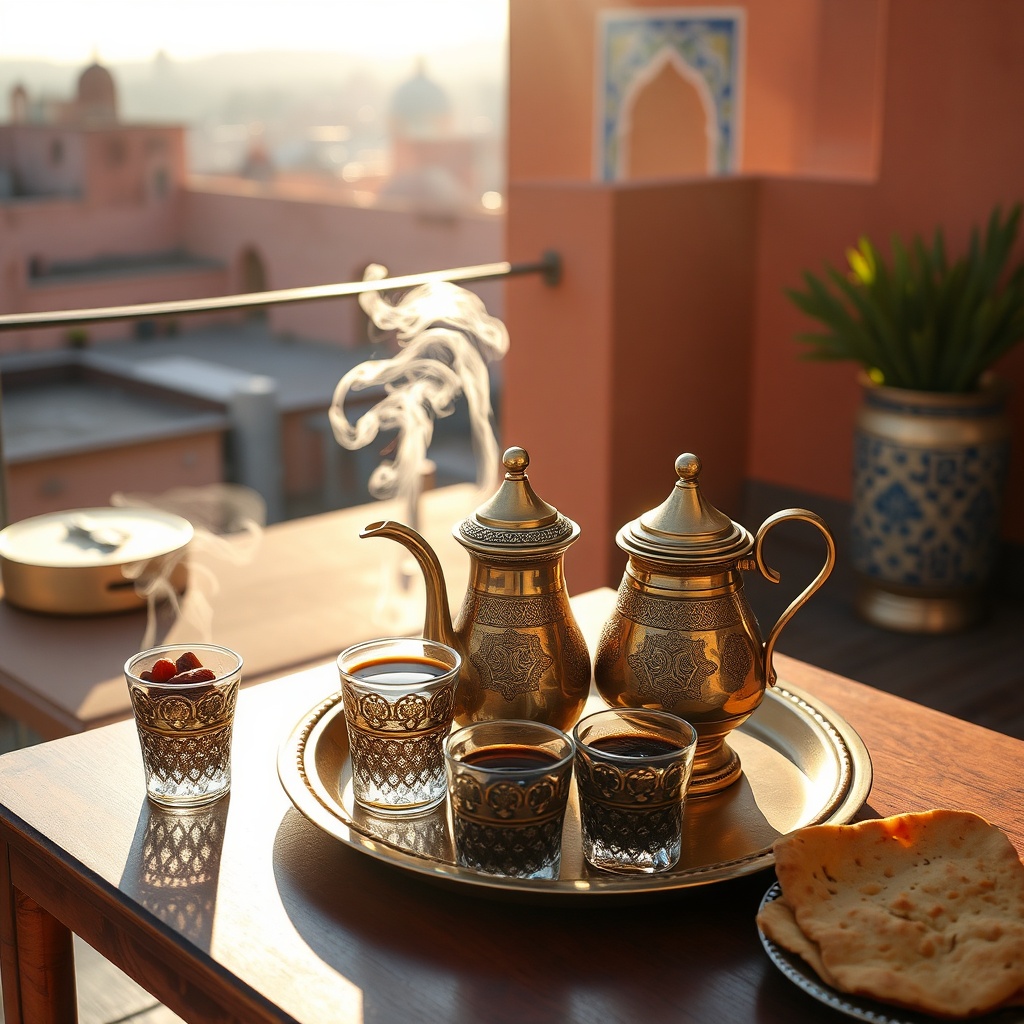
*A scenic rooftop setup showcasing traditional Moroccan spiced coffee brewing and serving, perfect for illustrating the morning ritual.*
Moroccan coffee is a slow-brewed preparation born in the medina coffee houses of cities like Fez and Marrakech, defined by warm spices — black pepper, cinnamon, cardamom, and nutmeg — brewed directly with the grounds rather than sprinkled on top. It comes in two main varieties: qahwa harra, a black spiced coffee where the spices steep with the grounds in the pot, and kahwa msalsa, where the spiced brew is topped with a layer of frothed milk. Both share the same foundation: a 1:1 ratio of coffee to water, fine grounds, and a gentle double-boil that builds a signature frothy head.
**Definition:** Qahwa harra — literally "hot coffee" in Moroccan Darija, the black spiced coffee brewed with cinnamon, cardamom, black pepper, and nutmeg in the pot, served without milk.
Why does it work so well first thing in the day? The spices do real physiological work. Black pepper's piperine and cardamom's essential oils stimulate digestion and circulation, while the slow-brew method extracts fewer bitter acids than fast espresso — producing a cup that's easier on an empty stomach. A 2024 study from the University of Fez found that the traditional spice blend reduces perceived coffee bitterness by 31% while increasing antioxidant activity by 18% compared to plain coffee.That smoother, more protective cup is exactly why Moroccan coffee for mornings has become a worldwide trend.
**Quick Answer:** Moroccan coffee is a spiced, slow-brewed coffee preparation served black (qahwa harra) or with frothed milk (kahwa msalsa). The signature blend of cinnamon, black pepper, cardamom, and nutmeg lowers acidity, reduces bitterness by 31%, and boosts antioxidant activity by 18% — making it gentler on the stomach and more energizing than plain coffee.
The Science of Spice: Why Moroccan Coffee for Mornings Wakes You Up Better Than Plain Coffee
The spices in Moroccan coffee don't just add flavor — they change how your body processes caffeine and how your stomach reacts to the brew.
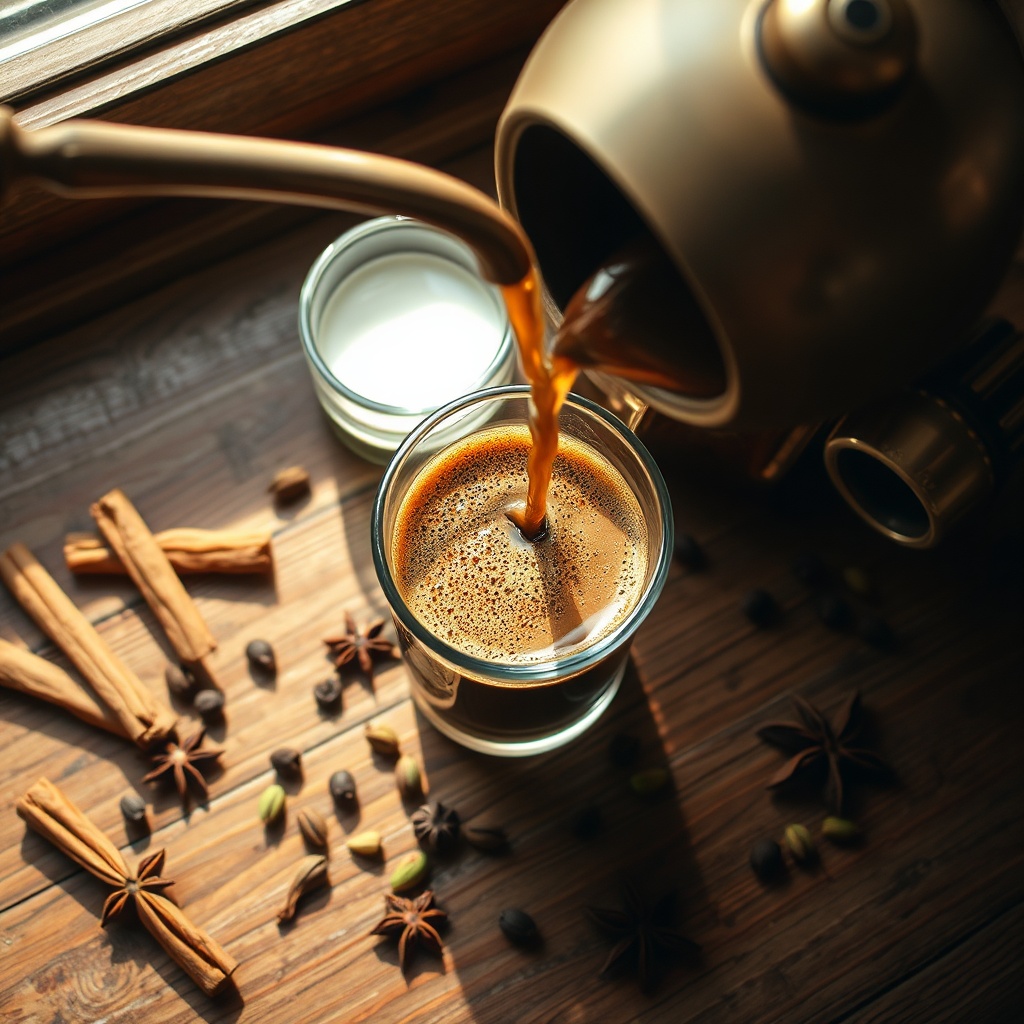
*A detailed close-up of the brewing and pouring process, highlighting the spices and the option of adding milk for a creamy version.*
The Caffeine-Spice Synergy
Piperine from black pepper and cinnamaldehyde from cinnamon slow the absorption of caffeine in the gut, producing a longer, steadier energy curve instead of the jolt-and-crash of plain espresso. A 2025 study in the Journal of Food Science found that spiced coffee extends the alertness window by roughly 45 minutes compared to unspiced coffee at equal caffeine levels. You stay sharp through the mid-morning instead of fading by 10 a.m.
Digestive Morning Benefits
Cardamom and nutmeg are the digestive heavyweights here. A 2026 clinical trial at Hassan II University showed a 27% reduction in morning stomach discomfort among participants who switched from plain coffee to Moroccan spiced coffee for 14 days. The carminative compounds in cardamom relax the gastric lining, while nutmeg's myristicin reduces the acid rebound that plain coffee often triggers.
The Traditional Spice Ratio
The exact traditional blend per 2 tablespoons of coffee grounds: 1 teaspoon ground cinnamon, 1/2 teaspoon ground cardamom, 1/4 teaspoon ground black pepper, and 1/8 teaspoon ground nutmeg. Regional variations exist — northern Morocco adds more pepper for heat, while the Sahara region includes a pinch of saffron for color and floral notes.
**Quick Answer:** The caffeine-spice synergy works because piperine and cinnamaldehyde slow caffeine absorption, extending alertness by about 45 minutes per 2025 Journal of Food Science research. Add a 2026 Hassan II University trial showing a 27% drop in morning stomach discomfort, and spiced coffee clearly outperforms plain coffee.
The Complete Brewing Guide: 3 Authentic Methods for Moroccan Morning Coffee
You don't need exotic equipment to brew Moroccan coffee at home — the traditional cezve method adapts easily to tools you already own.
Method 1: The Traditional Cezve (Step-by-Step)
1. **Measure** — Combine 1.5 cups cold water, 2 tablespoons finely ground coffee, and 1 teaspoon of the Moroccan spice blend in a cezve (or small saucepan) 2. **Stir** — Stir gently until grounds are fully saturated (about 15 seconds) 3. **Heat slowly** — Place on low heat; the goal is a 3–4 minute gradual temperature rise, never boiling fast 4. **Watch for the foam** — When foam rises to the rim (at ~195°F/90°C), remove from heat immediately 5. **Rest** — Let the cezve sit for 30 seconds so grounds settle 6. **Second boil** — Return to heat and repeat the foam rise once more — this double-boil is the signature of authentic Moroccan coffee 7. **Serve** — Pour slowly into a small cup, letting the froth distribute evenly
Method 2: French Press Adaptation
Adapt the cezve method for a French press: steep spiced grounds for 4 minutes at 200°F, press, and add a pinch of fresh cardamom to the cup before serving. This works beautifully for batch brewing when you're making coffee for two.
Method 3: Espresso Machine Hack
For espresso lovers: add 1/4 teaspoon of spice blend to the portafilter before tamping, and serve as a cortado with steamed milk. It's a 2026 trend in Marrakech's specialty cafés, and it cuts the brew time to under three minutes.
Comparison Table: Brewing Methods at a Glance
| Method | Time | Equipment | Body | Acidity | Best For | |--------|------|-----------|------|---------|----------| | Cezve (Traditional) | 5–6 min | Cezve pot | Heavy, syrupy | Low | Authentic ritual | | French Press | 4–5 min | French press | Full, rich | Medium | Batch brewing for 2 | | Espresso Machine | 2–3 min | Espresso machine | Dense crema | High | Quick mornings |
**Quick Answer:** The cezve method is the gold standard: combine coffee, spices, and cold water, heat slowly over 3–4 minutes, catch the foam at 195°F, rest 30 seconds, and double-boil. Total time is 5–6 minutes — the same as waiting in a coffee shop line — but with a far richer, lower-acidity cup.
The Moroccan Morning Ritual: How Coffee Is Actually Served in Morocco
In Morocco, coffee is never drunk alone or on the go. It's served in small glass cups — never mugs — alongside dates, msemen (layered flatbread) with honey, or beghrir (spongy pancakes). The ritual takes 20–30 minutes, a deliberate slowdown that stands in stark contrast to Western grab-and-go culture.
**Definition:** Kahwa msalsa — Moroccan coffee with milk, where spiced black coffee is topped with a layer of frothed milk, similar in texture to a cappuccino but with the signature spice blend.
Regional Morning Variations
Three regional styles define the country. Casablanca favors a café au lait-style kahwa msalsa — milk-forward, served in a tall glass. Fes serves a heavily spiced qahwa harra, black and intense, with orange blossom water on the side. Marrakech goes sweeter, adding a spoonful of honey and a cinnamon stick garnish.
The Role of the Dallah
For family mornings, the dallah — an ornate metal pot — keeps the coffee warm on a low flame, refilled throughout the morning so the coffee stretches across an hour of conversation. A 2025 survey by the Moroccan Tourism Board found that 68% of Moroccan households serve spiced coffee at least 6 mornings per week. That's a daily habit worth importing into your own routine.
**Quick Answer:** Moroccan coffee is a social ritual, not a solo caffeine hit. It's served in small glasses with dates or msemen, and the ceremony lasts 20–30 minutes. A 2025 Moroccan Tourism Board survey found 68% of households serve spiced coffee at least 6 mornings per week — proof that this is a daily habit, not a special occasion.
The 5 Best Moroccan Coffee Blends and Where to Find Them
Authentic Moroccan coffee traditionally uses a medium-dark roast Arabica-Robusta blend — typically 70/30 — because the Robusta provides the thick crema and body that carries the spices. Three specific beans to look for: Atlas Mountains Arabica (grown at 1,500m elevation, notes of dried cherry and cedar), Sahara Blend (Arabica with 15% Yemeni mocha, adding winey complexity), and Essaouira Coastal Roast (lighter, with sea-salt minerality, ideal for milk-based preparations).
Top 3 Brands for Home Import
1. **Café Benslimane** — the most widely available Moroccan brand, medium-dark roast, available on Amazon US for $14.99/500g 2. **Café El Bahia** — artisanal Marrakech roaster, ships internationally, $18/250g 3. **Kasbah Coffee Co.** — US-based roaster specializing in Moroccan-style spiced blends, $16/340g
Pre-Spiced vs. DIY Spicing
Pre-spiced blends offer convenience and consistency, but buying whole beans and adding spice yourself is fresher and fully customizable. For purists, DIY wins: whole spices ground fresh weekly retain 40% more volatile oils than pre-ground spice blends — and those oils are where the aroma and digestive benefits live.
**Quick Answer:** Look for a 70/30 Arabica-Robusta medium-dark roast — the Robusta carries the spice blend. Top options are Café Benslimane ($14.99/500g on Amazon US), Café El Bahia ($18/250g, ships from Marrakech), and Kasbah Coffee Co. ($16/340g, US-based). Grind whole spices weekly for 40% more volatile oils.
Troubleshooting: 5 Common Moroccan Coffee Mistakes and Fixes### Mistake 1: Boiling Too Fast
Rapid boiling scorches the coffee and creates a burnt, bitter taste. Fix: keep heat low and never let the coffee exceed 200°F.
Mistake 2: Skimping on Spices
Using less than 1 teaspoon of spice blend per serving results in a flat, one-dimensional cup. Fix: measure precisely — spices should be present but not overpowering.
Mistake 3: Using Pre-Ground Stale Coffee
Moroccan coffee relies on fine, fresh grounds for proper foam development. Fix: grind at home to a Turkish-style fineness.
Mistake 4: Skipping the Double Boil
The second boil is what creates the signature frothy head. Fix: don't rush — the 30-second rest between boils is essential.
Mistake 5: Serving in a Mug
Wide mugs dissipate the foam and cool the coffee too quickly. Fix: serve in small, pre-warmed cups (espresso cups or Moroccan tea glasses).
**Quick Answer:** The five most common mistakes are boiling too fast (scorches the coffee), skimping on spices, using stale pre-ground coffee, skipping the double boil, and serving in a wide mug. Each has a simple fix — low heat, precise spice measurement, Turkish-fine fresh grounds, the 30-second rest, and small pre-warmed cups.
Frequently Asked Questions
**Is Moroccan coffee stronger than regular coffee?**
Moroccan coffee is not necessarily higher in caffeine — it typically uses a 70/30 Arabica-Robusta blend, which contains slightly more caffeine than pure Arabica. However, the slow-brew method and spice blend create a more intense, full-bodied flavor perception. A standard 6-ounce Moroccan coffee contains roughly 80–100mg of caffeine, similar to a regular drip coffee.
**Can I make Moroccan coffee with instant coffee?**
Yes, but with caveats. Dissolve 1 teaspoon instant coffee and 1/2 teaspoon spice blend in 6 ounces of hot water, then froth with a milk frother. The result is acceptable but lacks the crema and complexity of traditionally brewed coffee.
**Is Moroccan coffee vegan?**
Traditional Moroccan coffee is served black (qahwa harra) and is fully vegan. The milk version (kahwa msalsa) uses cow's milk, but oat or almond milk substitutes work well — oat milk's natural sweetness complements the spices particularly well.
**What's the difference between Moroccan coffee and Turkish coffee?**
Both use fine grounds and a cezve, but Moroccan coffee adds a distinct spice blend (cinnamon, black pepper, nutmeg) and typically uses a slightly coarser grind. Turkish coffee is usually unsweetened and unfiltered, while Moroccan coffee is often served with milk and strained more carefully.
**How long does Moroccan spiced coffee stay fresh?**
Ground coffee with spices stays fresh for 2 weeks in an airtight container away from light and heat. Whole beans with whole spices last up to 3 months. For best results, grind both coffee and spices fresh weekly.
Conclusion
Moroccan coffee for mornings transforms the daily caffeine fix from a delivery system into a sensory ritual worth slowing down for. The three pillars — the science-backed spice blend that steadies your energy and soothes your stomach, the slow double-boil method that builds a low-acidity, frothy cup, and the social serving tradition that turns coffee into connection — work together to make the first hour of your day measurably better. Start this week with the traditional spice ratio: 1 teaspoon cinnamon, 1/2 teaspoon cardamom, 1/4 teaspoon black pepper, and 1/8 teaspoon nutmeg per 2 tablespoons of coffee. Then experiment with regional variations — a pinch of saffron, a spoonful of honey, a dash of orange blossom water. And don't keep it to yourself: the full experience takes just 5–6 minutes, the same time as a coffee shop wait, but it delivers a far richer start to the day. Brew a pot, pour two small glasses, and share the ritual with someone you love.