
What Is Moroccan Coffee Culture Really About?
The scent of roasted beans mingles with the sweet perfume of mint and the low hum of conversation. This is the sensory signature of a Moroccan café, a space that anchors neighborhoods and daily life. While mint tea often claims the spotlight as the national drink, Moroccan coffee culture is a distinct and equally vital practice, defined by ritual, community, and a unique blend of tradition and modernity. This article explores the heart of this culture, from the iconic nous-nous to the evolving specialty coffee scene, offering a guide to experiencing it like a local.
- Moroccan coffee culture is primarily a social ritual centered on hospitality and community bonding, not just caffeine consumption. - The preparation and serving of coffee is a performance of respect and generosity, with the signature spiced "nous-nous" symbolizing modern urban life. - Coffee consumption is rapidly growing, particularly among younger generations, and is reshaping urban café culture. - The traditional café is a democratic "third place," distinct from the private, domestic ritual of mint tea. - Understanding the etiquette and terminology is essential to participating authentically in Moroccan social life.
The Complete Answer: What Is Moroccan Coffee Culture?
**Quick Answer:** Moroccan coffee culture is a vibrant social practice centered on the public café, where drinks like the "nous-nous" are consumed as part of a daily ritual of community, conversation, and hospitality. It stands in contrast to the more private, domestic ceremony of mint tea.
Definition and Core Essence
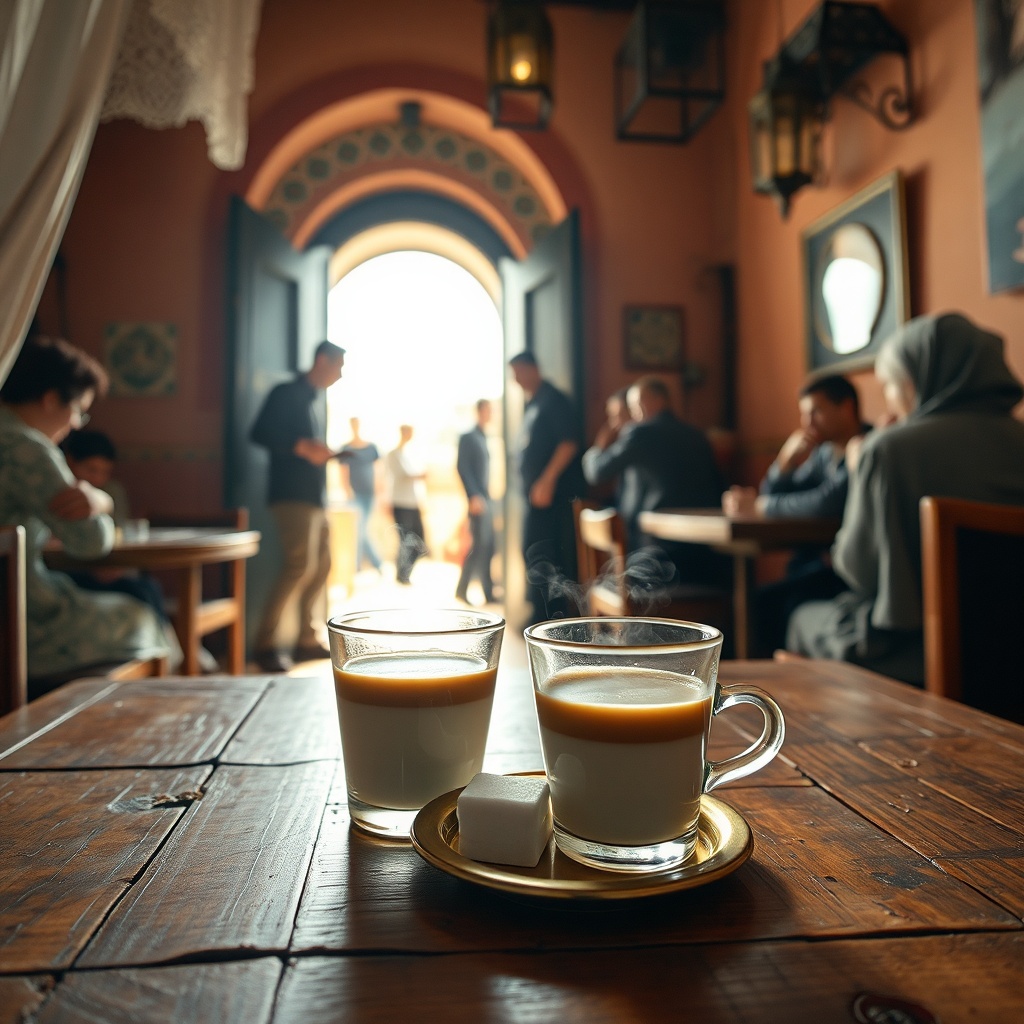
*Illustrates the traditional public café experience where coffee serves as a catalyst for conversation and neighborhood connection.*
Moroccan coffee culture is the sum of practices, rituals, and social meanings surrounding coffee consumption in Morocco. It is fundamentally a daily social ritual, most often performed in the public spaces of cafés. This communal, outward-facing nature is its defining characteristic, contrasting sharply with the more private, domestic ritual of Moroccan mint tea, which is typically reserved for home and formal hospitality.
The Historical and Cultural Context
While the exact timeline of coffee's arrival in Morocco is a subject of historical nuance, its journey from an elite beverage to a mass daily habit mirrors the country's broader modernization. The rise of coffee culture is deeply connected to urbanization and the development of a modern public sphere. As cities like Casablanca and Rabat grew, so did the café as a meeting point for merchants, intellectuals, and the general public, cementing coffee's role in the social fabric.

*Highlights the growing specialty coffee movement and its integration into Morocco’s changing social landscape.*
The "Nous-Nous" Phenomenon
**Definition:** Nous-nous is the signature Moroccan coffee drink, consisting of half espresso and half milk, served in a small glass. The name is a phonetic rendering of "half-half" in French.
The nous-nous is the undisputed star of Moroccan café culture. Its name, a playful adaptation of the French "moitié-moitié" (half-half), perfectly captures its composition. This drink is more than just a beverage; it is a symbol of modern, urban life. It bridges the gap between the robust, intense espresso tradition introduced by European influence and a local preference for milkier, smoother drinks. Ordering a nous-nous is a statement of belonging in the modern Moroccan city.
The Ritual of the Moroccan Café — A Social Institution
The Café as the "Third Place"
The Moroccan café is a quintessential "third place"—a social environment distinct from home and work. It is a democratic space where people from all walks of life come together. The typical atmosphere is one of relaxed observation; patrons engage in conversation, people-watch from street-facing terraces, read a newspaper, or simply watch the world go by. It is a hub for community news, political discussion, and social bonding.
The Etiquette of Ordering and Serving
Ordering coffee in Morocco is a simple act with its own unspoken rules. Here is a step-by-step guide to navigating the café experience like a local:
1. **Find a seat:** Choose your spot, whether at the bar, inside, or on the terrace. The waiter will come to you. 2. **Order with confidence:** Use the key terms. A **nous-nous** (half espresso, half milk) is the standard. A **kahwa** is a black coffee. A **café cassé** is a coffee with just a drop of milk. You can also specify your sugar preference: **"sans sucre"** (without sugar) or **"avec sucre"** (with sugar). 3. **Receive your coffee:** The drink arrives in a small, handleless glass on a saucer, almost always accompanied by a small glass of water. 4. **Pay the bill:** When you are ready to leave, signal the waiter by raising your hand or catching his eye. The bill is brought to your table and payment is made there. Tipping is appreciated but not mandatory.
Regional and Urban Variations
Café culture in major cities like Casablanca, Rabat, and Marrakech is more dynamic and diverse than in smaller towns. In the metropolises, you'll find a mix of traditional, no-frills cafés and modern, stylish establishments. The influence of French, Spanish, and Italian café models is evident in the prevalence of espresso-based drinks and the design of many urban cafés. More recently, a new wave of specialty coffee shops has emerged, creating a distinct sub-culture focused on brewing methods, bean origin, and a curated experience.
From Bean to Cup — The Craft of Moroccan Coffee Preparation
Traditional Preparation Methods
At home, the classic method for making **kahwa** (coffee) is using a stovetop pot, similar to a cezve or a moka pot. This method produces a strong, robust brew. A unique Moroccan touch is the use of spices; cinnamon, cardamom, and even a hint of pepper are often added to the grounds, creating a warm, complex flavor profile known as Moroccan spice infused coffee. The drink is then poured with care into a small, handleless cup, a vessel sometimes referred to as a **khouya**, which is part of the ritual itself.
The Rise of Specialty Coffee in Morocco
The specialty coffee scene in Morocco is growing rapidly, particularly in urban centers like Casablanca and Rabat. This "third-wave" movement is led by a new generation of baristas and café owners who are adapting international trends to local tastes. They are introducing pour-over methods and high-quality espresso drinks, and there is a growing interest in single-origin beans and brewing education. This movement is creating a new space that sits alongside the traditional café, appealing to a clientele that values connoisseurship and the craft of the drink.
A Comparison Table: Traditional vs. Modern Moroccan Coffee
| Feature | Traditional (Home/Café) | Modern (Specialty) | | :--- | :--- | :--- | | **Preparation** | Stovetop (cezve/moka) | Espresso machine, pour-over | | **Flavor Profile** | Spiced, robust, often sweetened | Clean, nuanced, often unspiced | | **Primary Setting** | Home, neighborhood café | Trendy café, specialty shop | | **Social Function** | Daily ritual, hospitality | Experience, connoisseurship | | **Key Drink** | Kahwa, nous-nous | Filter coffee, flat white |
Coffee vs. Tea — Navigating Morocco's Two Beverage Cultures
The Dominance of Mint Tea
Mint tea, or **atay**, is the undisputed national drink of Morocco. Its ceremonial preparation and serving are deeply embedded in the culture, symbolizing hospitality, friendship, and generosity. The ritual often involves the elaborate pouring of tea from a height to create a foam, and it is typically served in a communal pot across multiple small glasses. Tea is the drink of home, of formal gatherings, and of family life.
Coffee's Distinct Niche and Growing Popularity
In contrast to tea's domestic and ceremonial role, coffee is positioned as the "modern" alternative, associated with work, speed, and the rhythms of urban life. The demographics driving coffee consumption are primarily youth, professionals, and urban dwellers. Rather than competing, the two beverages coexist and serve different social functions. Tea is for home and hospitality; coffee is for the public sphere, work breaks, and socializing outside the home.
A Comparison Table: Coffee vs. Mint Tea in Morocco
| Feature | Coffee (Kahwa) | Mint Tea (Atay) | | :--- | :--- | :--- | | **Primary Context** | Public café, work, socializing | Home, formal hospitality, family | | **Preparation** | Quick, individual | Elaborate, communal | | **Serving** | Small glass, immediate | Pot (teapot), multiple glasses | | **Cultural Symbol** | Modernity, urban life | Tradition, hospitality | | **Time of Day** | Morning, throughout the day | After meals, social gatherings |
A Step-by-Step Guide to Experiencing Moroccan Coffee Culture Like a Local
Step 1: Choose the Right Café
Look for a café with a lively atmosphere, often with outdoor seating where you can observe the street. The best experiences are found in neighborhood spots where locals gather, away from the main tourist areas. A café that is busy with regulars is a sign that you've found the right place.
Step 2: Order with Confidence
Learn the key terms to order like a local. **Nous-nous** (half-half) is the most popular choice. **Kahwa** is black coffee, and **café cassé** is a coffee with a drop of milk. Don't forget to specify your sugar preference (**sans sucre** or **avec sucre**) and enjoy the small glass of water that accompanies your drink.
Step 3: Settle In and Observe
Understand that lingering is not just accepted but expected. The café is a place to relax and watch the world go by. Embrace the social rhythm: people-watching, reading, or chatting with friends. There is no pressure to finish your drink quickly.
Step 4: Pay the Bill at the Right Time
When you are ready to leave, catch the waiter's eye to signal that you'd like the bill. Payment is always made at the table. Tipping is appreciated but not strictly necessary.
Step 5: Embrace the "No Rush" Philosophy
Don't be in a hurry. The experience is about the moment, not just the caffeine. Accept that the coffee ritual is a pause in the day, a moment of connection and reflection. This is the heart of Moroccan café society.
The Future of Moroccan Coffee Culture
The Impact of Globalization and Youth Culture
Social media and global trends are having a significant impact on café aesthetics and menus. The rise of "Instagrammable" cafés with modern design and innovative drinks is attracting a younger clientele, shaping the future of the café experience. This new wave is not replacing the traditional café but adding a new layer to the culture.
The Sustainability and Local Sourcing Movement
There is a growing interest in creating a "farm-to-cup" movement, potentially using beans from local producers. While the Moroccan coffee roasting techniques are well-established, the opportunity to source beans domestically presents both challenges and opportunities for local roasters. This movement could further differentiate Moroccan coffee on the global stage.
Coffee as a Cultural Bridge
Modern Moroccan coffee culture is a dynamic, hybrid space that blends tradition with innovation. It honors the past through its ritualistic café culture and embraces the future through specialty brewing and global trends. This evolution ensures that Moroccan coffee culture remains a vibrant and essential part of the country's social identity.
Frequently Asked Questions (FAQ)
What is the most popular coffee drink in Morocco?
The nous-nous, a half espresso, half milk drink, is the most iconic and widely ordered coffee beverage in Moroccan cafés.
How do you say "coffee" in Moroccan Arabic?
Kahwa is the common term for coffee, while nous-nous refers specifically to a half-and-half coffee with milk.
Is Moroccan coffee different from regular coffee?
Yes, traditional Moroccan coffee is often spiced with ingredients like cinnamon, cardamom, and sometimes pepper, giving it a unique flavor profile.
Can I find specialty coffee in Morocco?
Yes, the specialty coffee scene is growing rapidly in cities like Casablanca and Rabat, with a new wave of artisan roasters and cafés.
Do Moroccans drink coffee or tea more?
Mint tea is the national drink and remains dominant in homes and formal settings, but coffee is now a major daily ritual, especially in public cafés.
Conclusion
Moroccan coffee culture is a vibrant, social ritual that blends tradition with modernity. It is defined by the café as a social institution, the significance of the nous-nous, and its distinct role alongside the more traditional mint tea. To truly understand Morocco, one must not only sip its tea but also engage in its coffee culture—a practice of community, patience, and hospitality. Armed with this knowledge, you are ready to experience this rich culture firsthand. Find a café, order a nous-nous, and settle in for a moment of connection.