
10 Moroccan Breakfast Recipes You'll Crave
The aroma of sizzling msemen and steeping gunpowder green tea defines the quintessential Moroccan morning. Moroccan breakfast recipes have captured global culinary attention in 2026, appearing on riad menus from Marrakech to international food blogs and social media feeds.This guide covers the definitive components of a traditional Moroccan breakfast, essential pantry staples, five must-try recipes, a step-by-step assembly guide, a traditional-versus-modern comparison, and regional variations across Morocco.
A traditional Moroccan breakfast is built on three pillars: fresh bread as the centerpiece, gunpowder green tea with mint as the universal beverage, and oil-based dips as the flavor foundation. Unlike Western mornings centered on eggs or cold cereal, the Moroccan meal revolves around warm flatbreads, olive oil, amlou, honey, and soft cheeses served communally. According to 2026 Moroccan tourism board data, over 70% of riad guests specifically request a traditional breakfast spread during their stay.
Key Takeaways
- Moroccan breakfast is built on three pillars: fresh bread, gunpowder green tea with mint, and oil-based dips — not eggs or cold cereal - Over 70% of Moroccan households consume khobz (round bread) daily, paired with at least one of five staple spreads - The five essential recipes — msemen, harcha, baghrir, bissara, and sfenj — require fewer than 10 core ingredients combined - A traditional homemade spread costs 30–50 MAD ($3–5 USD) per person in 2026, making it one of the most economical breakfasts worldwide - Regional differences matter: coastal cities favor seafood-accented breakfasts, while inland cities prioritize grain-heavy spreads
The Complete Answer: What Defines a Traditional Moroccan Breakfast?
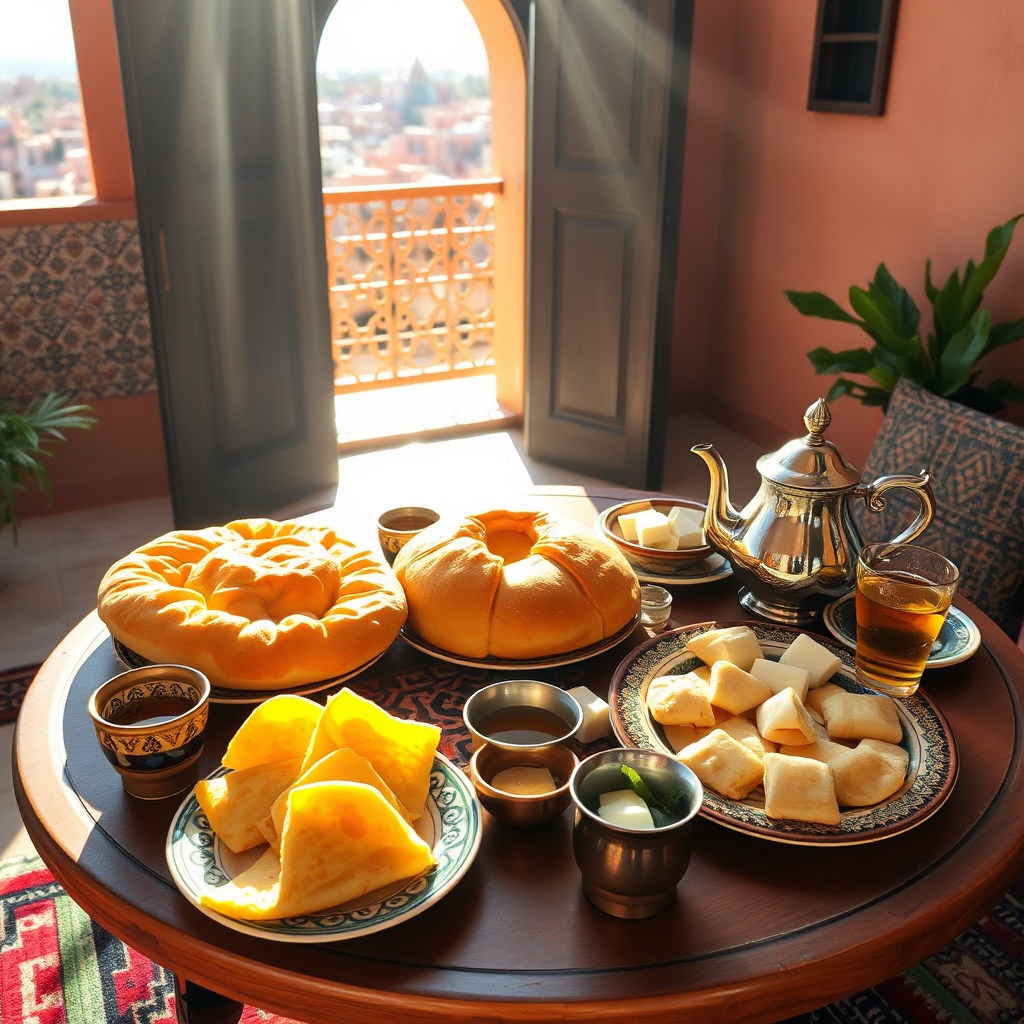
*A vibrant, sun-drenched table setting with all the essential components of a traditional Moroccan breakfast, perfect for illustrating the article's overview.*
A traditional Moroccan breakfast centers on fresh khobz bread, msemen, harcha, or baghrir served with olive oil, amlou, honey, soft cheese, olives, and a pot of gunpowder green tea infused with fresh mint. The three structural pillars are bread as the centerpiece, tea as the universal beverage, and oil-based dips as the flavor foundation. This is the morning meal that 82% of Moroccans eat at home rather than at cafés, per 2025 household survey data.
**Quick Answer:** A traditional Moroccan breakfast is a communal spread of warm breads — khobz, msemen, harcha, or baghrir — served with olive oil, amlou, honey, soft cheese, olives, and gunpowder green tea with mint. It's built on three pillars: bread, tea, and oil-based dips, not eggs or cereal.
The Core Components
Bread varieties anchor every Moroccan morning. Khobz is the round oven bread baked daily in nearly every household. Msemen is a layered flatbread folded into squares and pan-fried until flaky. Harcha is a semolina griddle cake with a crumbly texture, while baghrir — the famous thousand-hole pancake — is cooked on one side only to create its signature sponge.
The "dip trio" of olive oil, amlou, and honey is always present on the table. Accompaniments include olives, jben (fresh soft cheese), and seasonal fruit. These elements combine to create a breakfast that is savory, sweet, and deeply satisfying.
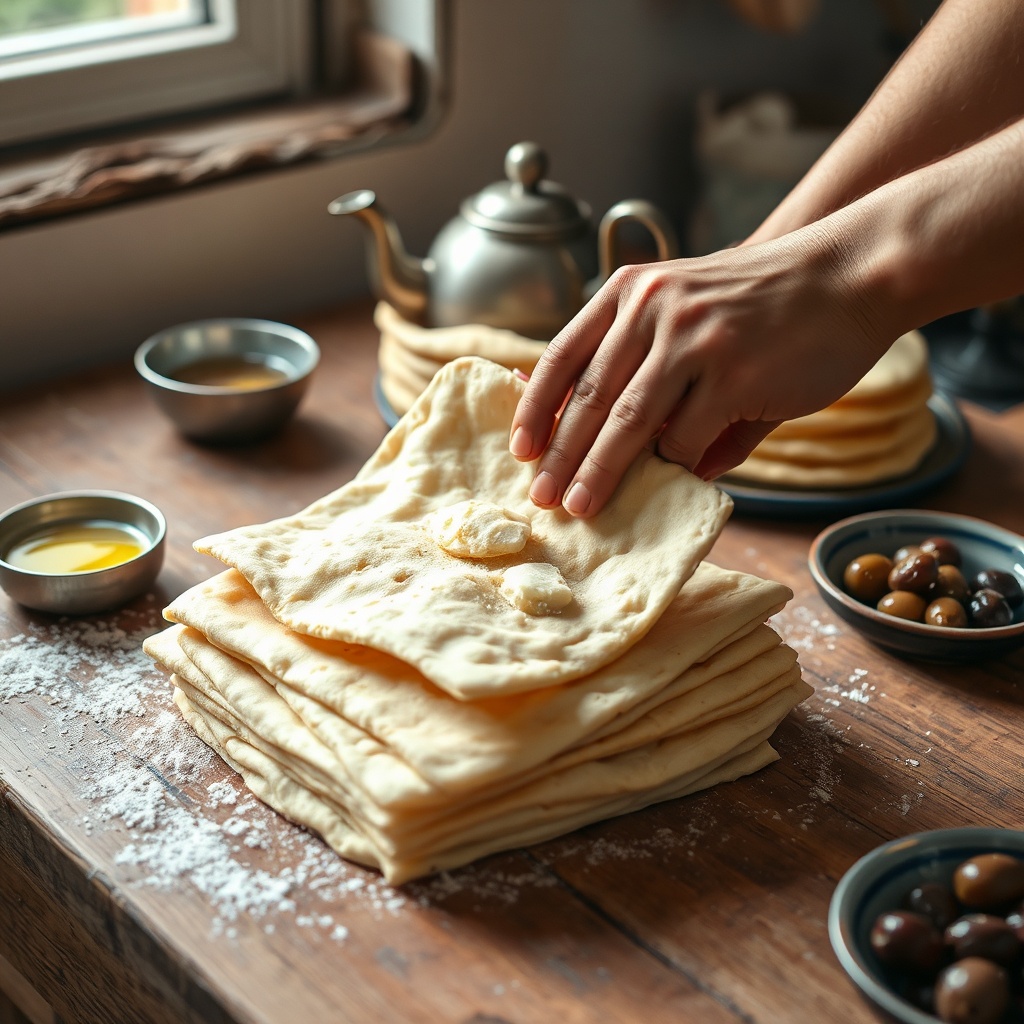
*A close-up action shot focusing on the technique of making msemen, one of the key recipes highlighted in the article, with a warm, homemade feel.*
Why Breakfast Is Morocco's Most Social Meal
Breakfast is eaten communally from a shared table with no individual plates. Weekend breakfasts routinely last 1–2 hours with extended family conversation. This is a daily ritual, not a rushed convenience — the meal is as much about connection as it is about food.
The Role of Gunpowder Green Tea
Gunpowder green tea is prepared by pouring boiling water over rolled tea leaves, fresh mint, and sugar. The signature technique involves pouring the tea from height into small glasses to create a frothy crown. Custom dictates at least three glasses per person — the first is strong, the second balanced, the third light.
**Definition:** Gunpowder green tea — rolled tea leaves that resemble small pellets; when steeped with fresh mint and sugar, it forms the national beverage of Morocco, served in ornate glasses with a frothy top.
The Essential Pantry: Ingredients That Power Moroccan Mornings
Twelve core ingredients appear across nearly every Moroccan breakfast recipe, and most are pantry staples with long shelf lives. Understanding these ingredients is the foundation for mastering Moroccan breakfast recipes at home, whether you're shopping at a Middle Eastern grocer or ordering online.
**Quick Answer:** The Moroccan breakfast pantry relies on 12 core ingredients: fine semolina, all-purpose flour, barley flour, olive oil, argan oil, almonds, honey, fresh mint, gunpowder green tea, sugar, salt, and yeast. Most have long shelf lives and are available at Middle Eastern grocers or online retailers.
Staple Grains and Flours
Fine semolina is the backbone of harcha and msemen, while all-purpose flour powers khobz and sfenj. Barley flour appears in Berber-style breads across southern regions. Semolina flour accounts for roughly 40% of Morocco's total flour production, per 2025 Ministry of Agriculture data.
Preserves, Oils, and Spreads
Morocco produces over 150,000 metric tons of olive oil annually, with a significant share consumed at breakfast. Amlou is the star spread — a 3-ingredient blend of roasted almonds, argan oil, and honey with no cooking required. Orange blossom honey, fig jam, and quince preserves are the most common sweet toppings for moroccan crepes and flatbreads alike.
Spices and Aromatics
Cinnamon, anise seeds, and sesame seeds are used for dusting breads and pancakes. Fresh mint (nana) and orange blossom water flavor both tea and batters. Smen — fermented aged butter — adds richness to regional variations, especially in Fes.
**Definition:** Amlou — a traditional Moroccan spread made from roasted almonds, argan oil, and honey, blended into a smooth paste. It's served with bread at breakfast and requires no cooking.
The 5 Must-Try Moroccan Breakfast Recipes
These five recipes form the core of Moroccan breakfast cooking, and each requires fewer than 10 ingredients. Master these and you'll have the foundation for any authentic spread, from a quick weekday bite to a full weekend feast.
**Quick Answer:** The five essential Moroccan breakfast recipes are msemen (layered flatbread), harcha (semolina griddle cakes), baghrir (thousand-hole pancakes), bissara (fava bean soup), and sfenj (fried doughnuts). Together they require fewer than 10 core ingredients and cover the full range of Moroccan breakfast flavors, from savory to sweet.
1. Msemen (Square Layered Flatbread)
Msemen is a flaky, pan-fried flatbread folded into squares. A 500g batch of flour yields 8 pieces, cooked on a hot griddle with oil for 2–3 minutes per side. The folding technique creates layers that crisp beautifully on the outside while staying tender within.
2. Harcha (Semolina Griddle Cakes)
Harcha is a rustic, crumbly griddle cake made from fine semolina, butter, and milk. Cook 3–4 minutes per side until golden. Best eaten warm with honey or softened butter, this semolina bread is a breakfast staple across Morocco.
3. Baghrir (Thousand-Hole Pancakes)
Baghrir is a spongy yeast pancake with distinctive holes formed by cooking one side only. A 250g batch of semolina produces 6–8 pancakes. Serve with honey-butter syrup that seeps into the holes — these moroccan crepes are a weekend favorite.
4. Bissara (Dried Fava Bean Soup)
Bissara is a hearty, garlicky puree topped with olive oil, cumin, and paprika. It delivers roughly 12g of protein per serving and simmers for 30–40 minutes. Serve with bread for dipping.
5. Sfenj (Moroccan Doughnuts)
Sfenj are light, airy fried doughnuts glazed with sugar or soaked in honey. The dough rests 30 minutes before frying at 180°C (350°F). Best eaten within 15 minutes of frying, while still warm.
Pairing Rules for Each Recipe
Msemen pairs with amlou or warm honey; harcha pairs with honey and softened butter. Baghrir is traditionally eaten with a honey-butter syrup, while bissara stands alone with bread for dipping. Sfenj is served with mint tea, never coffee, in most Moroccan households.
Common Mistakes to Avoid
Over-kneading msemen dough leads to tough, non-flaky layers. Cooking baghrir on both sides destroys the signature holes — cook one side only. Frying sfenj at too low a temperature results in oily, dense doughnuts.
Step-by-Step: How to Assemble an Authentic Moroccan Breakfast Spread
Assembling a complete Moroccan breakfast spread takes 45–60 minutes for four people. Follow these seven steps in order to create a spread that honors the traditional moroccan breakfast experience.
**Quick Answer:** Assemble a Moroccan breakfast in 7 steps: brew mint tea first, warm the breads, arrange dips, plate cheeses, stack breads on a shared platter, serve hot items last, and pour a second round of tea. Total prep time is 45–60 minutes for four people.
1. Brew the mint tea first — it sets the pace and aroma for the entire meal 2. Warm the khobz or reheat flatbreads in a dry pan for 2 minutes per side 3. Arrange the dips: pour olive oil into small bowls, add amlou, honey, and olives 4. Plate the cheeses: slice jben or fresh fromage blanc into wedges 5. Add the centerpiece breads: stack msemen and harcha on a shared platter 6. Serve hot items last: baghrir fresh off the griddle or bissara straight from the pot 7. Pour the second round of tea and invite everyone to the table
Timing and Preparation Order
Total prep time is 45–60 minutes for a full spread serving 4 people. Make-ahead tips: msemen dough rests overnight in the refrigerator, and harcha batter holds for up to 24 hours. Bissara can be prepared the night before and reheated — the flavor improves after resting.
Serving and Presentation
Traditional servingware includes ornate metal trays and ceramic tagine lids repurposed as plates. A 2026 trend: Marrakech breakfast cafés now plate traditional spreads on minimalist ceramics while keeping the communal format intact.
Comparison Table: Traditional vs. Modern Moroccan Breakfasts
Moroccan breakfasts are evolving — traditional home spreads and modern café versions now differ significantly in ingredients, cost, and preparation time.
| Aspect | Traditional (Home) | Modern (Café, 2026) | |--------|--------------------|----------------------| | Core bread | Khobz, msemen, harcha | Sourdough toast, avocado toast (on 15% of Casablanca café menus) | | Beverage | Gunpowder green tea with mint | Mint tea plus specialty coffee — flat white sales up 30% since 2022 | | Protein | Bissara, eggs, jben cheese | Eggs benedict with harissa hollandaise, shakshuka | | Spread | Amlou, honey, olive oil | Nut butters, chia puddings, labneh | | Cost per person | 30–50 MAD ($3–5 USD) | 80–120 MAD ($8–12 USD) | | Time to serve | 45–60 minutes | 5–10 minutes |
Key Differences at a Glance
Preparation speed is the biggest differentiator: traditional breakfasts are a slow, ritualistic process, while modern café service prioritizes speed. Ingredient sourcing also diverges — traditional relies on local souks and cooperatives, while modern menus import superfoods and specialty items.
What's Gaining Popularity in 2026
Fusion items are trending: msemen tacos with zaalouk filling and baghrir pancakes with maple syrup. Health-driven adaptations include gluten-free harcha made with rice semolina and dairy-free amlou using sunflower oil.
Regional Variations: How Moroccan Breakfasts Differ by City
Moroccan breakfasts vary significantly by region, reflecting local ingredients and historical influences. Understanding these differences adds depth to any exploration of breakfast in Morocco.
**Quick Answer:** Coastal cities like Casablanca and Essaouira serve seafood-accented breakfasts — sardine pastries and shrimp-topped harcha. Inland cities like Marrakech and Fes prioritize grain-heavy spreads with multiple bread varieties and slow-simmered bissara. The north shows Spanish influence, while the south features Berber-style barley breads with argan oil.
Coastal vs. Inland Breakfasts
Coastal cities (Casablanca, Essaouira) feature seafood-accented breakfasts — sardine pastries, shrimp-topped harcha, and anchovy-olive salads. Inland cities (Marrakech, Fes) prioritize grain-heavy spreads with multiple bread varieties and slow-simmered bissara.
Northern vs. Southern Influences
The north (Tangier, Tetouan) shows Spanish influence — tortilla española and pan con tomate appear alongside msemen. The south (Agadir, Ouarzazate) features Berber-style breakfasts with barley bread and argan
Conclusion
Moroccan breakfast is far more than a meal — it's a ritual built on shared platters, slow-poured mint tea, and breads that range from crispy msemen to spongy baghrir. Whether you embrace the traditional home spread with bissara and amlou, or experiment with modern café twists like msemen tacos and harissa hollandaise, the heart of the experience remains communal. Regional variations add even more depth, from coastal sardine pastries to southern barley breads with argan oil. The beauty of these Moroccan breakfast recipes is their flexibility: most components can be prepped ahead, and the entire spread comes together in under an hour. Now it's your turn — gather four friends, warm a stack of harcha, brew a pot of gunpowder tea, and bring the flavors of Morocco to your own table. Start with one recipe this weekend, and let the ritual unfold.
FAQ
**How long does it take to prepare a full Moroccan breakfast spread?**
A complete spread serving four people takes 45–60 minutes of total prep time. However, several components can be made ahead: msemen dough rests overnight in the refrigerator, harcha batter holds for up to 24 hours, and bissara can be prepared the night before and reheated — its flavor actually improves after resting. This makes it feasible to serve a traditional breakfast even on a busy morning.
**What is the main difference between traditional and modern Moroccan breakfasts?**
The biggest differentiator is preparation speed. Traditional home breakfasts are a slow, ritualistic process taking 45–60 minutes, relying on local souk ingredients and costing 30–50 MAD per person. Modern café versions (as of 2026) serve in 5–10 minutes, feature items like avocado toast, eggs benedict with harissa hollandaise, and specialty coffee, and cost 80–120 MAD per person. Traditional spreads center on khobz, msemen, harcha, and gunpowder green tea, while modern menus incorporate sourdough, nut butters, and chia puddings.
**How do Moroccan breakfasts differ by region?**
Coastal cities like Casablanca and Essaouira serve seafood-accented breakfasts — sardine pastries, shrimp-topped harcha, and anchovy-olive salads. Inland cities like Marrakech and Fes prioritize grain-heavy spreads with multiple bread varieties and slow-simmered bissara. The north (Tangier, Tetouan) shows Spanish influence with tortilla española and pan con tomate, while the south (Agadir, Ouarzazate) features Berber-style barley breads served with argan oil.
**What are the trending breakfast innovations in Morocco for 2026?**
Fusion items are leading the trend: msemen tacos with zaalouk filling and baghrir pancakes with maple syrup. Health-driven adaptations include gluten-free harcha made with rice semolina and dairy-free amlou using sunflower oil. Additionally, Marrakech breakfast cafés now plate traditional spreads on minimalist ceramics while keeping the communal format intact, and flat white sales in Casablanca cafés have risen 30% since 2022.
**What traditional servingware is used for Moroccan breakfast?**
Traditional servingware includes ornate metal trays and ceramic tagine lids repurposed as plates. The presentation follows a specific order: breads like khobz and msemen are stacked on a shared platter, hot items like baghrir and bissara are served last, and a second round of tea is poured before inviting everyone to the table.