
Buy Authentic Moroccan Goods Marrakech: Avoid Traps
The Ultimate Guide to Buy Authentic Moroccan Goods in Marrakech: Avoid Tourist Traps
Stepping into the Marrakech medina hits you with a wall of scents, sounds, and colors. However, the urge to buy authentic Moroccan goods Marrakech often leads travelers straight to stalls selling mass-produced imports from China rather than local treasures. The real magic lies not in the flashy tourist fronts, but in the dusty, sun-drenched workshops where artisans have honed their crafts for generations. Supporting these masters preserves cultural heritage and ensures your money goes directly to the community rather than middlemen. To navigate this maze, you must look beyond the surface and learn to distinguish genuine craftsmanship from factory-made replicas.
* Visit specific artisan quarters (Quissaria Satin) for raw materials and fixed-price cooperatives to avoid aggressive haggling. * Verify authenticity in rugs by checking for irregularities and knots per square inch rather than chemical perfection. * Negotiation is expected, but it should be respectful; aim for a fair market price rather than the absolute lowest possible. * Prioritize Argan oil products bearing the "GEOPA" or "Bio" labels to ensure they are sourced from legitimate women’s cooperatives.
The Complete Answer: Where to Buy Authentic Moroccan Goods in Marrakech
To buy authentic Moroccan goods Marrakech, you must target three specific pillars: location, material, and verification. Start your journey at Souk Semmarine for general goods, but quickly move to the Mellah for high-quality silver or the Bab Doukkala area for modern artisanal designs that blend tradition with contemporary flair. You should focus on purchasing raw materials like leather, ceramics, and textiles directly from the source rather than finished goods in tourist-heavy alleys. Always verify authenticity by choosing government-regulated cooperatives over independent street vendors to ensure quality and fair trade practices.
For a stress-free experience, visit the Ensemble Artisanal near the Bab Doukkala mosque. This government-regulated space guarantees fixed prices for authentic goods with over 40 different trades represented. It operates daily from 9 AM to 7 PM, providing a reliable environment where you can watch artisans work without the pressure of aggressive haggling. This complex is the safest bet for beginners looking to invest in genuine Moroccan craftsmanship.
*** **Quick Answer Box 1:** To buy authentic Moroccan goods in Marrakech, focus on specific artisan quarters like Mellah for silver or Bab Doukkala for modern designs, and visit government-regulated places like Ensemble Artisanal for guaranteed quality and fixed prices. ***
The Artisanal Geography: Navigating the Specialized Souks
Authentic shopping in the medina requires a geographical strategy based on raw materials. You will find the concentrated "babouches" market near the Rahba Kedima square, where the air is thick with the smell of freshly treated leather. Just nearby lies the dyers' market, skeins of wool hang dripping in vibrant colors from the rooftops. For the most visceral experience, head north to the Chouara Tannery. This site has operated since the 11th century and uses traditional methods involving pigeon droppings and cow urine to treat hides. This natural process takes nearly a month to complete a single batch, resulting in the supple, durable leather that defines Moroccan goods.
Navigating these specialized zones allows you to bypass the general resellers. When you buy from the tanners or the dyers directly, you are purchasing the foundational elements of Moroccan craft. Look for the stalls covered in wool dust or leather scraps; these are the signs of active production. If a shop is too clean and perfectly lit, it is likely a retail front for imported goods.
*** **Definition Box:** **Babouches:** Traditional Moroccan leather slippers, often soft and colorful, worn both indoors and outdoors. They are typically handmade and can be found in various designs and levels of embellishment. ***
*** **Quick Answer Box 2:** Find "babouches" near Rahba Kedima and experience the Chouara Tannery for authentic leather production. ***
The Hidden Quarter of Metalworkers
Locate the metalworkers' alley by listening rather than looking. You will hear the rhythmic clanging of hammers against brass and copper near the spice market. This auditory trail leads you to the masters who create the famous Moroccan lanterns and tea trays. To identify hand-hammered metal versus machine-stamped imports, look for slight asymmetry in the patterns. Machine-perfect symmetry is a red flag for mass production. Authentic pieces will have tiny variations in the depth of the engraving, proving a human hand struck the metal.
These artisans often work in family units, passing techniques down from father to son. When you purchase a lantern here, you are buying a functional art piece that will last for decades. Ask the artisan to demonstrate the engraving process; they are usually proud to show their skill. This interaction not only authenticates the product but also gives you a story to bring home along with the item.
The Weavers’ District: Beyond the Tourist Rug Shops
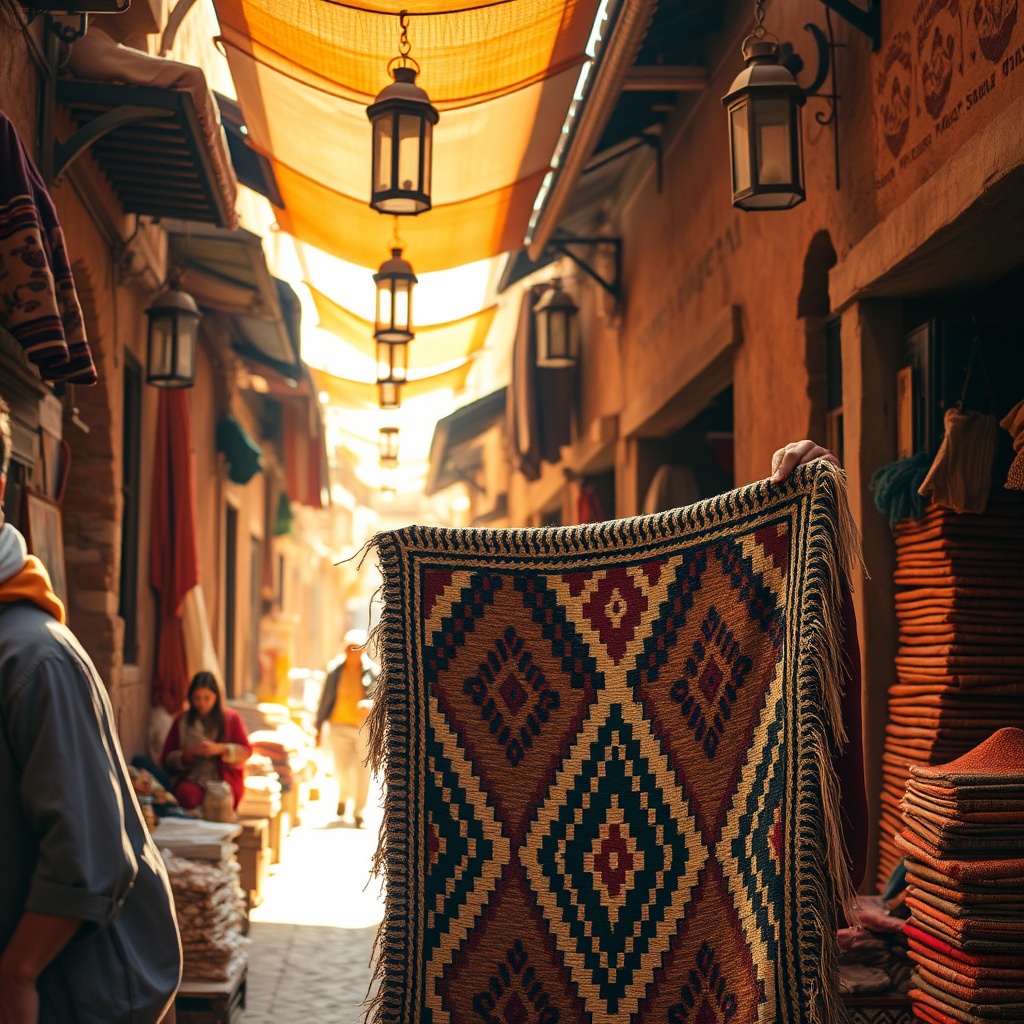
Avoid the high-pressure rug showrooms that employ "guides" to lure you off the street. Instead, seek out the actual weaving workshops found in the residential areas north of the main souks. Here, you can see women working on looms, creating the textiles that define Moroccan interior design. The significance of tribal patterns varies greatly between regions. The High Atlas tribes, like the Ait Ouaouzguite, favor geometric diamond shapes and bold reds, while the urban patterns of the medina tend to be more intricate and floral.
Visiting these workshops allows you to commission custom sizes or ask for specific vintage washes that mimic the look of an antique. A true weaver can explain the symbolism behind every motif in their carpet. This depth of knowledge is the best indicator of authenticity. If a seller cannot tell you the tribe of origin or the meaning of the symbols, you are likely looking at a commercial copy.
*** **Quick Answer Box 3:** For authentic rugs, bypass showrooms and visit weaving workshops in residential areas; seek weavers who can explain the symbolism of their designs. ***
Authenticity Check: How to Spot Fakes and Imports
Distinguishing goods made in China or Turkey from those made in Morocco requires a forensic approach. You must use touch, smell, and sight to verify quality. Authentic items often possess specific imperfections that prove human craftsmanship. A perfectly symmetrical ceramic plate with uniform, flat paint is likely factory-made. Conversely, a genuine piece will have slight variations in glaze thickness and hand-painted brushstrokes. For textiles, trust your nose; natural wool and vegetable dyes smell earthy, while synthetics have a chemical or plastic odor.
Always inspect the seams and stitching. On authentic leather bags, the stitching should be tight and irregular, often done by hand using a saddle stitch. Mass-produced bags use lock-stitch machines that unravel if one thread breaks. Do not be afraid to get close to the merchandise. A reputable artisan will encourage you to inspect the goods closely because they take pride in their materials. If a shopkeeper prevents you from touching the back of a rug or looking inside a bag, walk away immediately.
*** **Comparison Table:**
| Feature | Authentic Handmade Moroccan Goods | Mass-Produced Imports | | :------------------- | :--------------------------------------------- | :----------------------------------------------- | | **Craftsmanship** | Slight imperfections, unique variations | Perfect symmetry, uniform finish | | **Materials** | Natural fibers (wool, cotton), vegetable dyes | Synthetic materials, chemical dyes | | **Smell** | Earthy, natural (wool, leather, spices) | Chemical, plastic, artificial | | **Texture/Feel** | Rich, varied, often soft and pliable | Uniform, sometimes stiff or overly smooth | | **Stitching/Seams** | Irregular, strong, often saddle-stitched | Machine-perfect, can unravel if one thread breaks | | **Price** | Reflects quality and labor | Often suspiciously low | | **Artisan Interaction**| Willing to demonstrate, explain processes | Evasive, high-pressure sales tactics | ***
*** **Quick Answer Box 4:** To spot fakes, rely on touch and smell; look for natural material scents and slight imperfections as signs of authenticity. ***
The Leather Test: Smell and Texture
The smell of leather is the most immediate authenticity indicator. Vegetable-tanned leather, used by traditional tanneries, smells earthy, rich, and soft. In contrast, chrome-tanned leather, common in cheap imports, emits a sharp, chemical odor that can cause headaches. When buying "babouche" slippers, feel the texture. High-quality goat leather, known as "city" leather, is supple and molds to your foot immediately. "Desert" leather, made from camel or sheep, is thicker and more durable, often used for bags and belts rather than soft slippers.
Squeeze the leather gently. Authentic vegetable-tanned hide will wrinkle slightly but bounce back, showing a rich patina. Faux or chemically treated leather often feels stiff, plastic-like, or excessively smooth. Check the color on the inside versus the outside. Natural dyes penetrate the hide, so the color should be similar on both sides. If the inside is a stark white or different color while the outside is bright red, the dye is likely superficial and chemical-based.
Textile and Carpet Verification
To verify a rug, perform the "burn test" if allowed. Clip a tiny fiber from the tassel and burn it; natural wool turns to ash and smells like burning hair, while synthetic fibers melt into a hard plastic bead and smell like burning plastic. You must also check the back of the rug. A genuine hand-knotted rug will look almost as distinct on the back as it does on the front because the rows of knots are visible. Machine-made rugs have a backing fabric that obscures the weave.
Density is a critical metric. A high-quality authentic Moroccan rug typically features a density of at least 50,000 to 100,000 knots per square meter. Mass-produced versions often have significantly lower counts or are simply glued to a backing. Run your hand across the pile; high-quality wool feels oily and lanolin-rich to the touch. If it feels dry or brittle, the wool has been over-processed or is synthetic. Do not let a seller rush this inspection; a rug is a significant investment that requires careful scrutiny.
*** **Quick Answer Box 5:** Verify rugs by checking the back for visible knots and performing a burn test on a fiber; real wool burns to ash and smells like hair. ***
The Ethical Purchase: Cooperatives and Fair Trade
Shift your focus to the social impact of your purchase. Buying from government-sanctioned cooperatives ensures your money goes directly to the workers rather than middlemen. This is particularly vital in the Argan oil sector. Women’s cooperatives provide employment and education in rural areas where opportunities are scarce. According to UNESCO data updated in 2026, the Argan-based agro-sylvo-pastoral system within the region provides a livelihood to approximately 3 million people. By purchasing authentic oil, you are supporting a massive ecosystem of families.
Look for cooperatives that display certifications or allow you to observe the production process. Ethical shopping means paying a fair price that reflects the labor involved. If a price seems too good to be true, someone along the supply chain is being exploited. Ask the cooperative leader how the profits are distributed. Transparent organizations will happily explain that proceeds go to wages, education, and healthcare for the workers. This transparency is the hallmark of a fair trade establishment.
*** **Quick Answer Box 6:** Support ethical shopping by buying from women's Argan cooperatives, which provide livelihoods for approximately 3 million people. ***
Government-Backed Artisanal Complexes
If the chaos of the souk feels overwhelming, visit government-backed complexes like Ensemble Artisanal. These locations operate on a fixed-price basis, eliminating the stress of negotiation. While prices are higher than in the souks, the quality is guaranteed, and you avoid the "tourist tax" often added by aggressive vendors. More importantly, the artisans here are salaried employees with social security benefits, ensuring their economic stability.
These complexes serve as museums as much as markets. You can watch craftsmen carve wood, weave fabric, and beat brass in real-time. This educational aspect justifies the higher price point. You are paying for the assurance of authenticity and the preservation of the craft. Keep receipts from these purchases, as they are official documents that verify the origin of the goods, which can be helpful for customs purposes when you return home.
Supporting the Future: Young Designers and Modern Fusion
Authenticity does not only mean antique; it also means innovative design rooted in tradition. Visit concept stores like "33 Rue Majorelle" that blend traditional techniques with modern aesthetics. These spaces feature young designers who are reinterpreting Moroccan heritage for the contemporary world. You will find minimalist ceramics, updated textile prints, and avant-garde fashion that still utilize local materials like wool, clay, and leather.
Supporting these designers helps keep the crafts alive by making them relevant to a modern audience. An item purchased here supports a new generation of artisans who are pushing the boundaries of their trade. These stores often act as incubators for talent, providing the infrastructure and exposure that young artists need to thrive globally. If your taste leans toward modern minimalism, these shops offer the best of both worlds: authentic manufacturing with a current design sensibility.
*** **Quick Answer Box 7:** Explore contemporary Moroccan design at concept stores like 33 Rue Majorelle for modern takes on traditional crafts. ***
Mastering the Souk: A Step-by-Step Guide to Negotiation
Negotiation in Marrakech is a social ritual, not a financial battle. The process is about building a relationship with the shopkeeper, not just getting the lowest price. It often begins with an invitation for mint tea, which signals the start of the transaction. Accepting the tea is polite and shows you respect the vendor's hospitality. Never rush this interaction. The shopkeeper is assessing your genuine interest, and you are assessing the item's quality and the vendor's honesty.
Understand the psychology of the sale. A vendor's initial price is often an "opening bid" calculated based on their perception of your wealth. Your counter-offer should be respectful but firm. The goal is to reach a "fair market price" that leaves both parties satisfied. If you agree too quickly, you may overpay, but if you are too aggressive, you insult the artisan's work. The best deals happen when both parties smile at the final number.
*** **Step-by-Step List:** The 5-Step Respectful Negotiation Protocol 1. **Express Interest & Ask Price:** Show genuine interest in an item and ask for the initial price. 2. **Offer Respectful Counter:** Make a counter-offer that is significantly lower but still reasonable (e.g., 30-50% of the initial price). 3. **Engage & Discuss:** Discuss the item's quality, materials, and your offer. Be prepared for friendly back-and-forth. 4. **Meet in the Middle:** Aim for a price that feels fair to you and acceptable to the vendor. 5. **Conclude with Gratitude:** Finalize the deal with a handshake and express thanks, regardless of the outcome. ***
*** **Quick Answer Box 8:** Negotiation is a social ritual; start with tea, be respectful, and aim for a price that satisfies both you and the vendor. ***