
Berber Crafts: The Art Of Moroccan Handicrafts
Berber Crafts: The Art of Moroccan Handicrafts
The air in the medina of Marrakech carries the scent of cedarwood, saffron, and damp clay. Sunlight filters through slatted reed canopies, casting striped shadows across stacks of handwoven rugs draped over cedar shelves. A potter's wheel spins in a side alley, the craftsman's feet rhythmically pressing the pedal as his hands shape a terracotta tagine from wet earth. Down another passage, a metalsmith taps intricate filigree into a brass tray, each strike producing a sharp ring that echoes off walls lined with leather poufs and hand-emagined slippers. Every object you encounter in these labyrinthine souks carries a story — a lineage of knowledge passed from parent to child across hundreds of years. These are Berber crafts: the art of Moroccan handicrafts, born from the creative genius of the Amazigh people, who have inhabited North Africa for well over four millennia. Understanding this tradition means stepping into a world where art, identity, and daily survival have always been inseparable.
The Historical Roots of Berber Craft Traditions### Origins and Cultural Significance
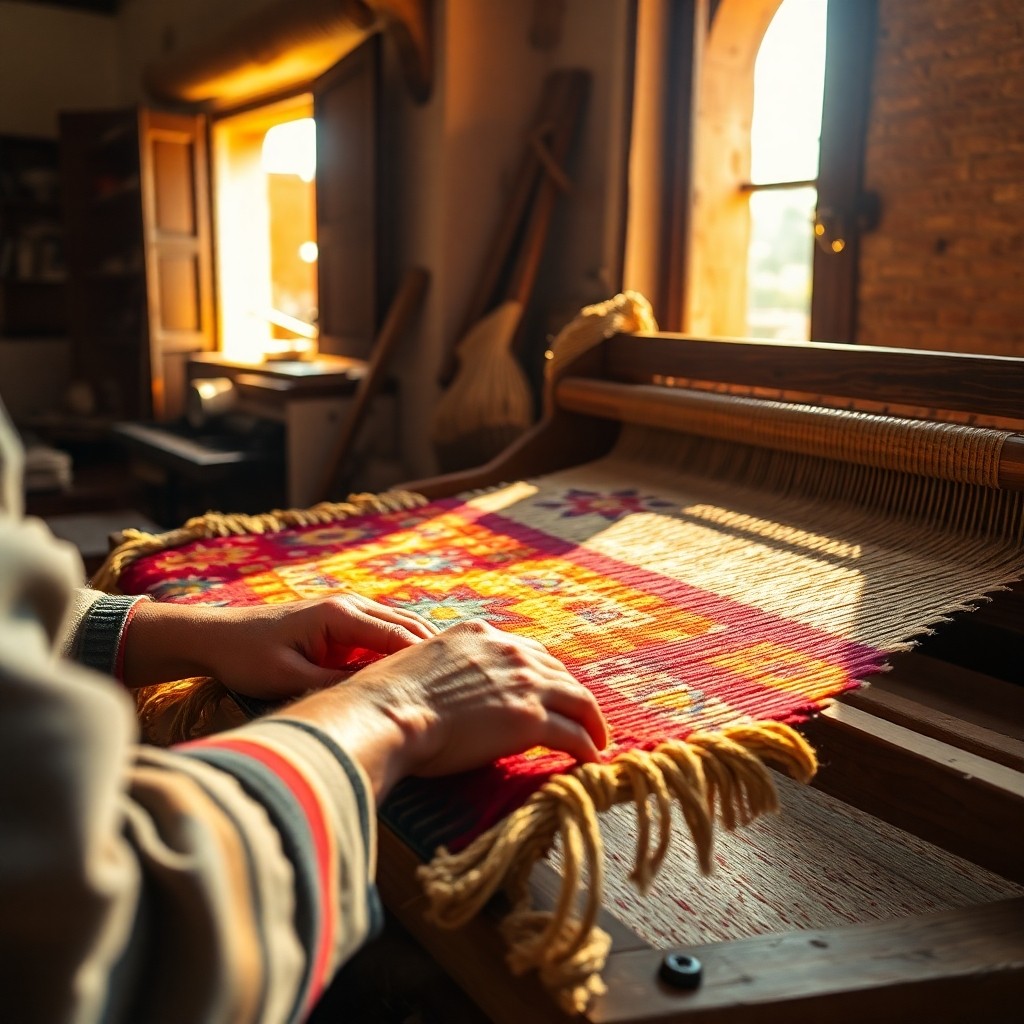
*A traditional Berber artisan hand-weaving a vibrant Moroccan rug on a wooden loom, showcasing the intricate craft passed down through generations.*
The Berber — or Amazigh — people are the indigenous inhabitants of a vast stretch of North Africa, from the oases of southern Morocco to the Canary Islands and eastward into Libya. Their artisanal traditions predate the arrival of Arabs, Romans, and Phoenicians in the region. Archaeological evidence suggests that Amazigh communities were weaving textiles, tanning leather, and shaping clay vessels as early as 2,000 years ago. These crafts were never purely decorative. A rug provided insulation against the freezing Atlas Mountains nights. A clay amphora stored precious grain and water across arid plains. A silver brooch held a woman's wrapped garment together and signaled her tribal affiliation.
Crafts served as both functional tools and cultural anchors for communities whose nomadic or semi-nomadic lifestyles demanded portability and durability. When Amazigh families moved seasonally between highland pastures and desert fringes, they carried objects that embodied their identity — woven mats that doubled as prayer rugs, jewelry that functioned as portable wealth, and talismans that offered spiritual protection. Over centuries of invasions, from the Roman Empire to French colonial rule, these traditions quietly resisted assimilation. The continuity of Berber craft practices represents one of the most enduring examples of cultural preservation in North Africa. Today, an estimated 25 to 30 million Amazigh people across Morocco, Algeria, Mali, Niger, and Libya continue to draw on these ancestral skills, ensuring that their heritage remains a living tradition rather than a museum relic. Organizations such as the UNESCO Intangible Cultural Heritage program have recognized the importance of safeguarding these practices for future generations.
Symbolism and Meaning in Berber Motifs
Every zigzag, diamond, and cross woven into a Berber textile or etched into a piece of jewelry carries intentional meaning. These geometric motifs constitute a visual language that has communicated beliefs, social status, and spiritual protections for centuries. The diamond shape, one of the most common patterns found in Kenzadi Moroccan home decor, represents the eye — a ward against malevolent forces. Zigzag lines evoke flowing water or serpentine movement, symbolizing life, fertility, and the continuity of the natural world. Crosses, particularly those with branching arms, reference the four cardinal directions and the balance of elemental forces.
The khamsa, or hand of Fatima, stands as the most widely recognized Berber symbol. This open-palmed figure, often with an eye at its center, is believed to deflect envy and protect against the "evil eye" — a concept deeply embedded in North African spiritual life. You'll find khamsa motifs hammered into silver pendants, carved into wooden door frames, and woven into the borders of ceremonial blankets. Regional variation adds further complexity to this symbolic vocabulary. Rugs from the Middle Atlas tend to feature dense, angular geometries in natural undyed wool, while pieces from the southern oases incorporate warmer tones and more fluid, organic shapes influenced by sub-Saharan trade routes. A trained eye can often identify a rug's tribal origin simply by analyzing its motifs and color palette, making each piece a geographic fingerprint as much as a work of art.
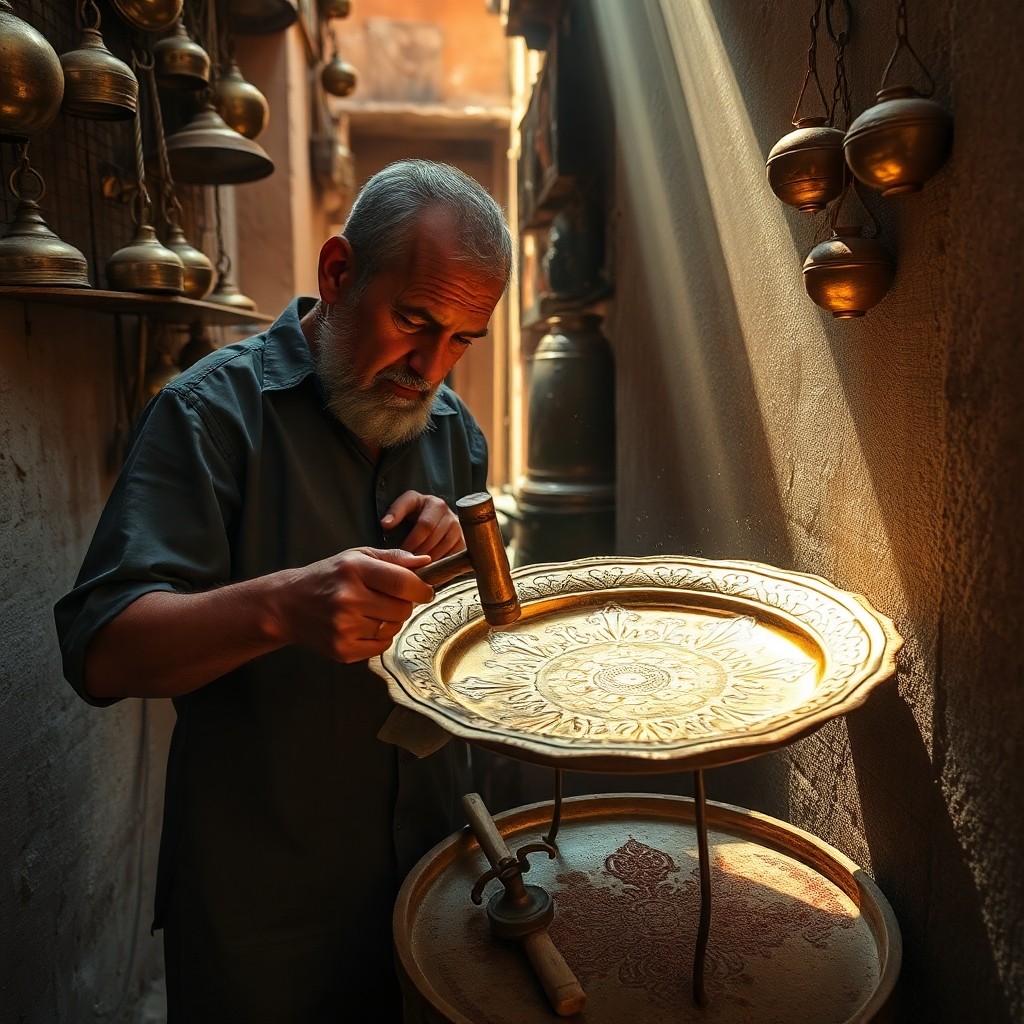
*A traditional Moroccan metalsmith crafting intricate filigree patterns on a brass tray in a sunlit alley of the Marrakech medina, highlighting centuries-old Amazigh metalworking heritage.*
Major Categories of Moroccan Handicrafts### Handwoven Textiles: Rugs, Blankets, and Shawls
Berber rug-making begins long before the first knot is tied. Women in rural communities shear their own sheep — typically during spring — and wash the raw wool in mountain streams to remove lanolin and debris. The cleaned fibers are carded using paired wooden paddles studded with metal teeth, then spun into yarn on a drop spindle. Depending on the desired texture, the yarn may be left thick and coarse for a dense pile or twisted finely for a flat-weave kilim.
The weaving itself takes place on a vertical loom anchored between a wall and a support beam. handmade Beni Ouarain rug originating from the Middle Atlas region, feature creamy ivory backgrounds with bold black or brown geometric lines — a minimalist aesthetic that has captivated interior designers worldwide. Azilal rugs, by contrast, burst with color: artisans incorporate naturally dyed yarns in saffron yellows, poppy reds, and indigo blues, often adding small decorative elements like sequins or braided tassels. Zemmouri rugs from the Kabylia-influenced regions lean toward tighter knotting patterns and more elaborate symbolic compositions.
A single medium-sized hand-knotted rug can take anywhere from six weeks to four months to complete, depending on knot density and design complexity. This labor-intensive process means a genuine Berber rug is not merely a floor covering — it is a document of time, skill, and cultural memory. Beyond rugs, Berber textile traditions include handira sequin shawls worn by brides during wedding ceremonies, and woolen blankets called "handira" or "aoued" that serve as bedding, cloaks, and ceremonial drapes. These textiles hold profound social significance. Rug-making has historically provided Berber women with one of the few avenues for economic independence, and the skills involved are passed down through generations as a rite of passage into adulthood.
Pottery, Ceramics, and Metalwork
Moroccan pottery traditions stretch back to the Neolithic period, with distinct regional schools developing around the clay deposits found in riverbeds and mountain quarries. Safi, a coastal city in western Morocco, is renowned for its ceramics studio collective, where artisans produce everything from large olive-ovens to delicate painted plates using techniques refined over centuries. The Safi school is known for its polychrome designs — cobalt blue, emerald green, and manganese brown painted onto a white tin glaze — often featuring floral and geometric patterns.
Fes, the old imperial city, has long been the epicenter of refined ceramic production. The famous Fes blue pottery uses a distinctive cobalt oxide glaze fired at temperatures around 1,000°C, producing the deep cerulean tones that adorn fountains, tabletops, and architectural tiles throughout the city. Berber potters in rural areas tend to work without glazes, producing unglazed terracotta vessels that breathe — ideal for storing water in hot, dry climates. These earthenware pots, called "tagias" or "ijjan," are often decorated with simple incised lines or burnished patterns.
Metalwork represents another pillar of Berber artisanal production. In cities like Marrakech and Taza, brass and copper workers hammer large trays from sheets of metal, then engrave them with arabesque and geometric designs using fine chisels called "mrichate." Silver jewelry, particularly the heavy fibula brooches and amber-bead necklaces made by Amazigh women in the Anti-Atlas mountains, reflects a Berber metalwork tradition that predates Islamic influence. Iron lanterns with pierced metalwork cast intricate shadow patterns across walls and ceilings, transforming ordinary rooms into spaces of visual wonder. These metal objects demonstrate the remarkable range of Berber crafts: the art of Moroccan handicrafts extends far beyond textiles into a full material culture.
The Artisans Behind the Crafts: People and Process### Artisan Communities and Craft Preservation
Certain Moroccan towns and villages have become synonymous with specific crafts, forming geographic clusters where entire communities organize around a single artisanal tradition. Tamegroute, a small village in the Draa Valley of southeastern Morocco, is famous for its distinctive green-glazed pottery. Every family in Tamegroute participates in pottery production in some capacity — mixing clay, shaping vessels, loading kilns, or selling finished pieces from roadside workshops. The village's pottery cooperative employs over 300 registered artisans and has become a destination for collectors seeking authentic pieces.
Ouarzazate, at the edge of the Sahara, serves as a hub for Berber rug cooperatives. Organizations like the Fair Trade Morocco network connect female weaving cooperatives with international buyers, ensuring artisans receive fair compensation. In the High Atlas, the village of Aït Hamza has gained recognition for its women-run argan oil and weaving cooperative, which supports over 150 families. Nationally, Morocco's Ministry of Crafts reports that the artisanal sector employs approximately 2.4 million people, with women comprising nearly 60% of the textile workforce. Government initiatives, including the "Artisanat 2020" strategy, have invested in training centers, marketing platforms, and quality certification programs to strengthen craft economies in rural areas.
Cooperatives play a particularly vital role in preserving Amazigh traditions. By pooling resources, sharing equipment, and negotiating collectively with buyers, these organizations give individual artisans access to markets that would otherwise remain out of reach. They also create spaces where elder craftspeople can train younger apprentices, ensuring technical knowledge does not disappear with aging generations. The growth of fair trade certification has further elevated the visibility of these cooperatives, connecting conscious consumers with ethically produced goods.
Step-by-Step: How a Traditional Berber Rug is Made
Creating a hand-knotted Berber rug involves a sequence of steps that demand patience, precision, and physical stamina. The process begins with shearing sheep — a task performed once a year, typically in April or May, using hand shears. A single sheep yields between 1.5 and 3 kilograms of raw wool, and a large rug may require wool from ten or more animals.
After shearing, the wool is washed in cold water and stretched to dry on flat rocks or rooftops. Carding follows: workers drag the fibers between two wooden paddles covered in wire bristles, aligning the strands into soft, fluffy rolags ready for spinning. Spinning transforms these rolags into continuous yarn using a drop spindle — a simple weighted shaft that twists the fibers as it rotates. A skilled spinner can produce 30 to 50 meters of yarn per hour.
The dyeing stage reveals the alchemy of natural dyeing. Traditional Berber artisans derive colors from local sources: indigo leaves for deep blue, pomegranate rinds for golden yellow, madder root for red, and iron-rich mud for black. Some of the most prized dyes come from cochineal insects, which produce a vivid crimson when crushed and simmered. The yarn soaks in dye baths for hours or days, then dries in the open air.
Weaving begins on a vertical warp-weighted loom. The artisan ties knots — either symmetrical (Turkish) or asymmetrical (Persian) — row by row, cutting the pile after each line to create the rug's surface. A dense Berber rug may contain 100 to 300 knots per square inch. Finishing involves trimming the pile to a uniform height, washing the completed rug, and securing the fringe. From shearing to final inspection, a single rug can require two to six months of dedicated labor.
Berber Crafts in Contemporary Design and Global Markets### From Souks to Global Interiors
The aesthetic vocabulary of Berber design has migrated far beyond the walls of Moroccan medinas. Over the past two decades, international interior designers have embraced the clean geometric lines, earthy palettes, and textural warmth of handwoven Berber textiles. Beni Ourain rugs, once confined to the homes of Atlas Mountain families, now anchor living rooms in Brooklyn lofts, London townhouses, and Tokyo apartments. The minimalist cream-and-black palette of these rugs complements modernist furniture, while their handcrafted imperfections add organic warmth to sleek, contemporary spaces.
Major furniture and home décor retailers have taken notice. Brands ranging from Restoration Hardware to West Elm have incorporated Berber-inspired designs into their collections, though these mass-market versions lack the material authenticity and cultural depth of genuine pieces. A growing counter-movement emphasizes direct sourcing from Moroccan artisans, championed by platforms like Mokhi and Nomad Morocco, which connect consumers with handcrafted goods made using traditional methods.
Fashion designers have also drawn on Berber visual language. The Amazigh silver jewelry tradition — with its heavy fibula brooch, triangle-shaped pendants, and amber beadwork — has influenced collections by designers including Joseph Altuzarra and Stella Jean. In 2019, the Victoria and Albert Museum in London hosted an exhibition on North African jewelry that prominently featured Berber silverwork, bringing renewed scholarly and public attention to these traditions. The demand for authentic, ethically sourced Moroccan handicrafts continues to grow as consumers increasingly prioritize provenance, sustainability, and cultural connection in their purchasing decisions.
Challenges and Opportunities for Berber Artisans
Despite growing global interest, Berber artisans face serious threats to their livelihoods. Mass-produced imitations — machine-woven rugs made in China and Turkey that mimic Berber patterns — flood international markets at a fraction of the handcrafted price. These counterfeits undercut authentic artisans who cannot compete on price while maintaining traditional methods and fair wages. Rural depopulation compounds the problem: young Moroccans increasingly migrate to cities for education and employment, leaving fewer people in the villages where craft traditions thrive.
Economic pressures push many families to abandon artisanal work for more immediately lucrative trades. A weaver who spends three months on a rug may earn less than a factory worker makes in the same period, creating a rational incentive to leave the craft behind. Climate change also threatens supply chains — droughts reduce sheep herds, water scarcity affects pottery production, and shifting weather patterns alter the availability of dye plants. For those seeking to support artisans directly, a Moroccan tea pot or a leather pouf can be excellent choices that directly support artisan communities.
However, multiple initiatives offer hope. Fair trade organizations provide guaranteed minimum prices and long-term purchasing commitments that stabilize artisan incomes. E-commerce platforms enable cooperatives to sell directly to international consumers, eliminating middlemen who historically absorbed much of the profit margin. UNESCO has recognized several Moroccan craft traditions on its Representative List of the Intangible Cultural Heritage of Humanity, raising global awareness and unlocking funding for preservation programs. The Moroccan government's "Label Maroc" certification program helps consumers identify genuine handcrafted products, creating a market advantage for authentic artisans. Digital storytelling — through social media, documentary films, and online marketplaces — allows artisans to share their personal narratives, building emotional connections with buyers who value the human story behind each object.
Conclusion
Berber crafts: the art of Moroccan handicrafts represent far more than decorative objects. They are living documents of Amazigh identity, repositories of ecological knowledge, and testaments to the resilience of communities that have maintained their creative traditions across millennia. Every hand-knotted rug, every glazed vessel, every hammered silver pendant carries within it the accumulated wisdom of generations — knowledge of materials, patterns, and meanings that cannot be replicated by machines or algorithms.
Supporting these traditions requires conscious action. When you choose to purchase from verified artisan cooperatives, fair trade organizations, or certified Moroccan heritage brands, you invest in the survival of a cultural ecosystem that enriches the entire world. Seek out genuine Berber crafts through reputable sources, ask questions about provenance and production methods, and share the stories of the artisans who made the objects in your home. The Amazigh people have preserved their heritage through centuries of upheaval. By valuing their work and amplifying their voices, you help ensure that these extraordinary traditions continue to thrive for generations to come.
**Meta Description:** Discover Berber crafts: the art of Moroccan handicrafts — explore ancient weaving techniques, symbolic motifs, artisan communities, and how Amazigh traditions shape modern design.